

Averrhoa carambola L.
Family
Oxalidaceae
Synonyms
None
Vernacular Names
|
Malaysia, Indonesia |
Belimbing manis. |
|
English |
Carambola, star fruit. |
|
Philippines |
Balimbing. |
|
Cambodia |
Spö. |
|
Laos |
Füang. |
|
Thailand |
Ma fueang. |
|
Vietnam |
Khê. |
|
French |
Carambolier. |
Geographical Distributions
Some authors seek the origin in tropical America (Brazil), from where it was supposedly taken to the Philippines. However, most authors support the Southeast Asian origin, for instance because there is a Sanskrit name for carambola. This crop is now grown all over the humid tropics and also in the subtropics.
Description
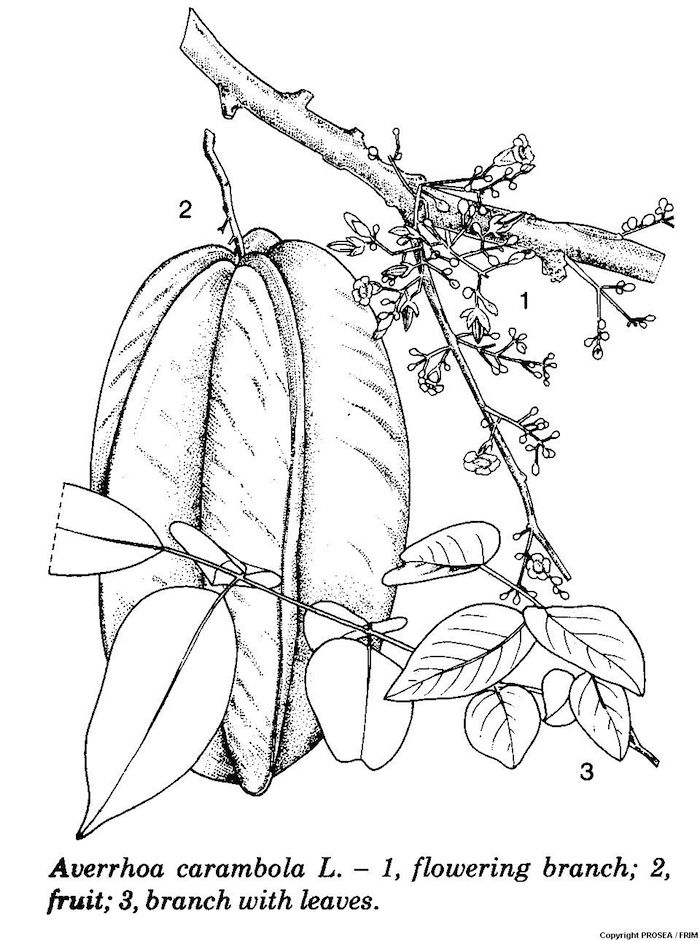
Averrhoa carambola is a small tree that can grow 6-9 m tall but sometimes can reach up to 15 m. It is a much branched, broad, bushy tree and the branches are usually drooping.
The leaves are 3-6-jugate.
The flowers are usually in axillary panicles and heterodistylous. The petals are coherent, measuring up to 8 mm long and light red with purple heart. The stamens are short rudimentary and lacking anthers.
The fruit is with 5 pronounced ribs, stellate in cross-section, and measuring up to 12.5 cm x 6 cm.
The seeds are with fleshy aril.
Ecology / Cultivation
Averrhoa carambola species prefers a climate with a dry season, thriving where teak (Tectona grandis L.f.) is at home, but also do well in wetter climates. It can be extended to frost-free subtropics; it is grown up to 300°S in Australia and 32°N in Israel. It has a high water requirement, but it needs well-drained soils of pH 5.5-6.5, and grows well on peat. Drought, flooding and salinity are not tolerated. Windbreaks are recommended on exposed sites.
Line Drawing / Photograph
Read More
1) Safety
References
-
Plant Resources of South-East Asia No.2: Edible fruits and nuts .