

Senna hirsuta (L.) Irwin & Barneby
Family
Leguminosae
Synonyms
Cassia hirsuta L., Cassia leptocarpa Benth.
Vernacular Names
|
Malaysia |
Sinteng, kacang kayu. |
|
English |
Woolly wild sensitive plant. |
|
Indonesia |
Kasingsat bulu (general), kasingsat (Sundanese). |
|
Philippines |
Balbala tufigan, katanda, tighiman (Tagalog). |
|
Thailand |
Phong pheng (northern), dapphit (peninsular). |
|
Vietnam |
Mu[oof]ng r[uwf]ng. |
Geographical Distributions
Senna hirsuta is a native of tropical America and is now distributed throughout Malaysia, Indo-China, Thailand and most countries in the Asian and African tropics. In Java, where it has long been known and has naturalised, it is more common in West Java than towards the east.
Description
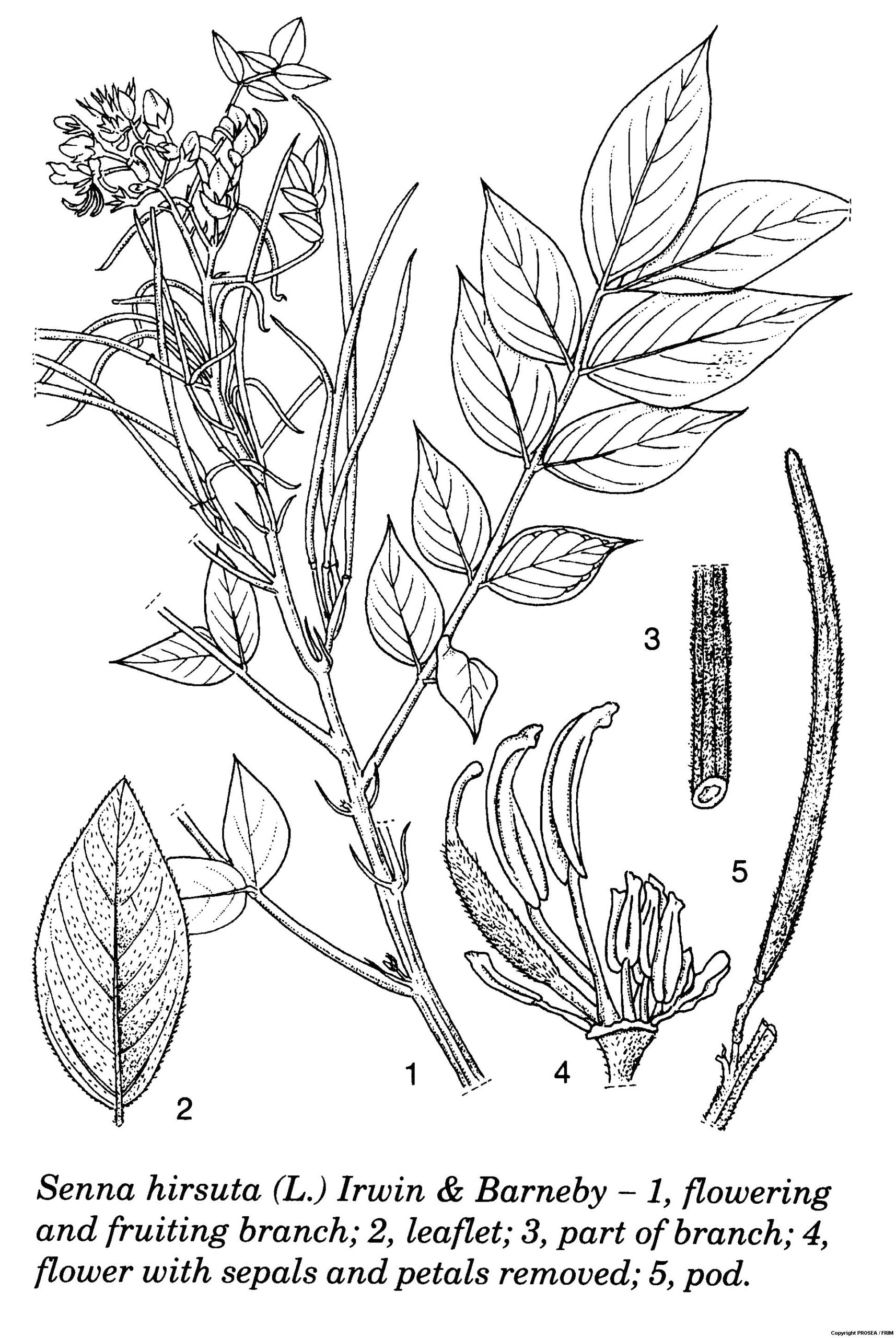
Senna hirsuta is an erect or diffuse, simple or several-stemmed herb that can grow up to 2.5 m tall. It becomes soft woody with age, with a fetid smell, and hairy but highly diverse in pubescence. The twigs are grooved, ribbed and densely hairy.
The leaves are 10-20 cm long and simply paripinnate. The stipules are linear-acute, measure 3-15 mm long and usually not persistent. The petiole is stout, up to 6.5 cm long, villose, and above the insertion with a sessile, oblong gland. The rachis is 3-16 cm long and glandless. The petiolules are up to 3.5 mm long, slender, villose and often not opposite. There are 2-8 pairs of leaflets which are strongly accrescent distally, chartaceous, lance-shaped-acuminate, and measuring 2-12.5 cm x 1-5 cm. They are 2-6 times as long as wide, slightly unequal-sided, with acute or rounded base, dark green and roughly villose on both surfaces.
The inflorescence is an axillary or rarely terminal, 2-8 flowered raceme (up to 45 in South America), measures 1(-8) cm long and aggregate in leafy panicles. The peduncle is up to 3 cm long. The bracts are linear to lance-shaped, measure 1.5-5 mm long and early caduceus. The bracteoles are absent. The pedicel is 1-2.5 cm long and pubescent. There are 5 sepals which are unequal. The 2 outer ones are small, orbicular, measure 4-7 mm long and hairy while the other 3 inner ones are larger, measure 7-10 mm long and partly hairless. There are 5 petals which are unequal, obovate, measure 8-28 m long, yellow, hairless and short-clawed. There are 10 stamens. Two of them are large with flat filaments 4-7 mm long and curved anthers 7-8 mm long that open by apical pores. The rest of the 8 stamens are smaller and staminoidal. The ovary is woolly and recurved. The style is short, hairless and with hairy subapical stigma.
The fruit is a falcate to straight angular pod, measuring 6-28 cm x 3-7 mm, septate, 50-90-seeded and stiff hairy. The seed is slightly compressed, orbicular, about 3 mm in diametre and dark olive coloured. The areole is 0.5-2.5 mm long and narrowly elliptical.
Ecology / Cultivation
In Southeast Asia, Senna hirsuta is found in plains and hilly areas up to 700 m altitude. It grows spontaneously in waste locations, along roadsides, railway embankments, dry ditches and in secondary forests. It is found in gardens and fields as a weed and prefers open locations.
Line Drawing / Photograph
References
- Plant Resources of South-East Asia No.11: Auxiliary plants.