

Dichrocephala integrifolia (L.f.) O. Kuntze
Family
Compositae
Synonyms
Dichrocephala latifolia (Lamk) DC., Dichrocephala bicolor (Roth) SchltdI.
Vernacular Names
|
Indonesia |
Jukut meurit (Sundanese), wedahan, seprah (Javanese). |
|
Cambodia |
Klet choum thorn, kombet choun. |
|
Laos |
Cho ke (Meos, Xiengkhouang). |
|
Thailand |
Phakchee doi (Chiang Mai), saap haeng, haeng khong (Phetchabun). |
|
Vietnam |
Rau chu[oo]i, l[uw][owx]ng s[ows]c l[as] nguy[ee]n. |
|
Papua New Guinea |
Taka (Wapanamanda, Enga), dekemp (Mt. Hagen, Western Highlands), dakumadan (Duman, Simbu). |
Geographical Distributions
Dichrocephala integrifolia occurs in tropical and subtropical Africa, India, Indo-China, southern China, Thailand, and throughout Malaysia, Indonesia (Kalimantan excluded) and the Philippines to Australia and the Pacific. It is naturalised in Italy and Turkey.
Description
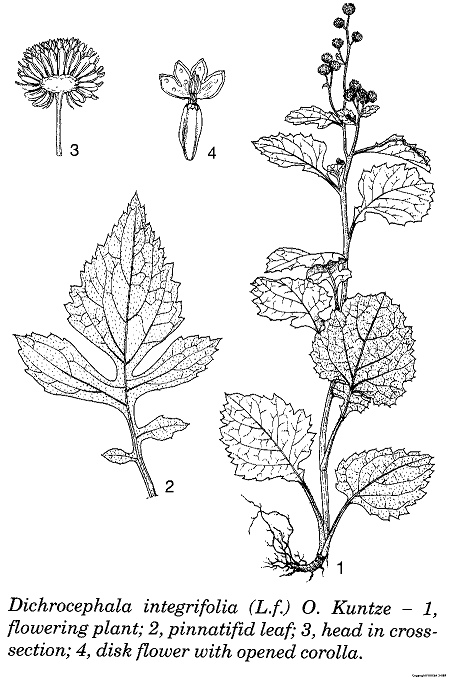
Dichrocephala integrifolia is an annual, erect or spreading, hairy and aromatic herb that can grow up to 20-60(-100) cm tall. It often branches at the base and roots at the nodes.
The leaves are arranged alternate, ovate to lance-shaped, measure 4-8(-13) cm x 2-3(-5) cm, very variable, simple or pinnatifid, with large terminal lobe, broadly ovate, and coarsely toothed. The first leaves are arranged alternate, petiolate, (broadly) ovate, obtuse at base, with entire margin or with a few teeth, apiculate at apex and hairless. The lateral lobes are in 1 or 2 pairs, obovate or oblong and dentate. The petiole is narrowly winged and 0-6 cm long.
The inflorescence is a small head in a lax axillary or terminal panicle. The peduncle is up to 2.5 cm long, with 2-seriate involucral bracts, lance-shaped, 5 mm long, with rounded head and 3-5 mm across. The flowers are all tubular but different in size, and marginal female flowers are numerous and slender. The petal is 0.5 mm long, with obscurely 5-dentate apex and from greyish-white to purplish. The bisexual disk flowers are with short-tubular petals of 1 mm long, with 3-4 lobes and greenish to yellowish-white. The marginal and disk flowers are differently coloured in one head. There are 4 stamens which are loosely coherent. The ovary is inferior with 1-2 awns. The style is elongated and with a flattened stigma.
The fruit is a small sub-cylindrical achene, 1 mm long, 2-ribbed at the edges and smooth. The pappus is absent or with 1-2 persistent awns.
The seedling is epigeal germination. The hypocotyls are short while the cotyledons are broadly ovate to broadly elliptical, measure 2 mm x 2.5 mm, petiolate, obtuse at base, apiculate at apex and hairless. The epicotyl is virtually absent.
Ecology / Cultivation
Dichrocephala integrifolia is a common weed of fallowed rice fields and moist waste places. It is also found on old clearings, along trails, drainage ditches and roads, especially on clay soils. In Java, it occurs abundantly on humid, mostly hard or stony soils. In Africa, it is found in grasslands and semi-shaded areas, and in Kenya, it is grazed by cattle. Dichrocephala integrifolia grows mainly between 500-3000 m altitude in the tropics. The flowering time is between April and November in regions with a cool and/or dry season, otherwise, it flowers throughout the year. The fruit of Dichrocephala integrifolia is hydrochorous.
Line Drawing / Photograph
References
-
Plant Resources of South-East Asia No.12(2): Medicinal and Poisonous Plants 2.