

Cosmos caudatus Kunth
Family
Compositae
Synonyms
Cosmos bipinnatus Ridley. non Cavanilles.
Vernacular Names
|
Malaysia |
Ulam raja, pelampong. |
|
English |
Cosmos. |
|
Indonesia |
Kenikir (Java), randa midang (West Java). |
|
Philippines |
Cosmos (Tagalog), turay-turay (Bisaya), onwad (Ifugao). |
|
Thailand |
Daoruang-phama (Bangkok), khamhae (Northern). |
Geographical Distributions
Cosmos caudatus is indigenous to tropical America. It was introduced by the Spaniards into the Philippines, possibly because it was used by them as a vegetable at sea. Now it is pantropical, including Southeast Asia, where it is cultivated but also occurs in a naturalised state.
Description
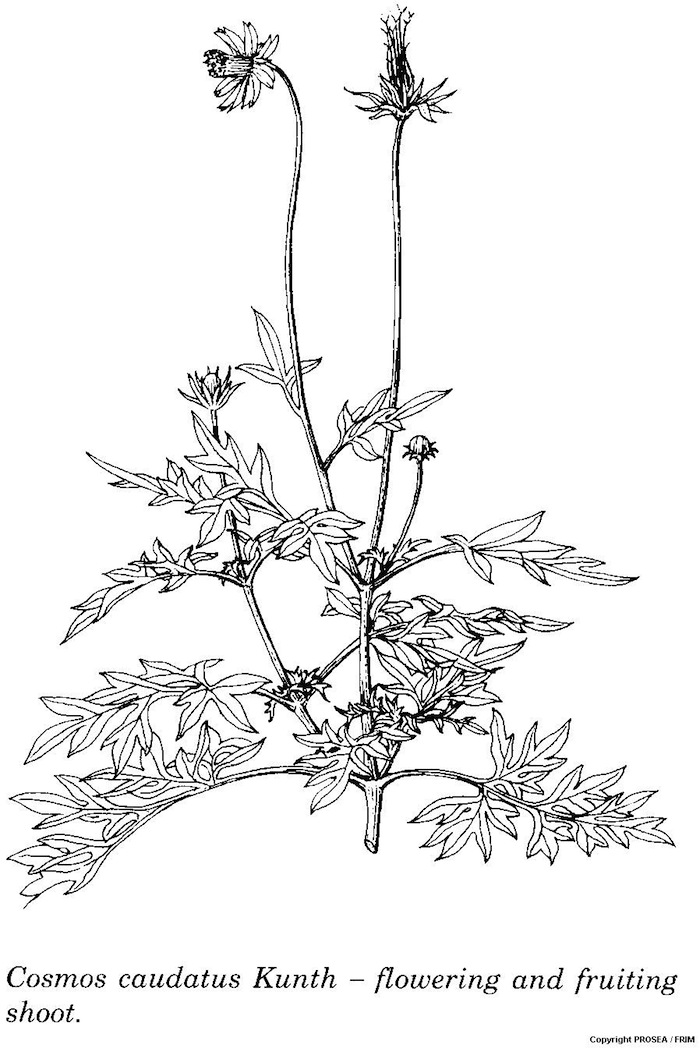
Cosmos caudatus is an erect, annual to short-lived perennial herb. The upper half is much branched, aromatic and up to 3 m tall. Its stem is longitudinally striate, green and often tinged with purple.
The leaves are arranged opposite, 2-4 pinnate or pinnatipartite, triangular-ovate in outline, measuring 2.5-20 cm x 1.5-20 cm, dark green above, nearly hairless and light green below with minute hairs. The petiole is up to 5 cm long. The ultimate leaf segments are oblong-lance-shaped and measuring 0.5-5 cm x 1-8 mm.
The inflorescence is a head, which is terminal (with other heads forming a lax panicle) or axillary, solitary and it is in the axils of the higher leaves. The peduncle is 5-30 cm long. There are 8 involucral bracts, which are linear-lance-shaped, measure 1.5-2 cm long and reflexed in the fruit. The 8 ray flowers are sterile, of which the ligules are linear lance-shaped, measuring 1-1.5 cm x 0.5 cm, mostly violet or reddish but seldom yellow or white. The tubular flowers are 0.7-1 cm long, bisexual, numerous and yellowish-green.
The fruit is one-seeded, linear-spindle-shaped, 4-angular, measures 1-3 cm long, black and ends with a beak with 2-3 short unequal awns.
Ecology / Cultivation
When not cultivated, Cosmos caudatus often occurs as a weed in the neighbourhood of human habitations, e.g. in fields and waste places, from the lowlands up to 1600 m altitude. It likes sunny places with a not-too-humid atmosphere and a fertile, pervious soil.
Line Drawing / Photograph
Read More
References
-
Plant Resources of South-East Asia No.8: Vegetables.