

Scientific Name
Garcinia atroviridis Griff. ex T.Anderson
Synonyms
No documentation
Vernacular Name
| Malaysia | Asam gelugur, asam gelugo, asam keping [1], gelugur [2] |
| English | Sliced tamarind, tamarind skin [2] |
| Thailand | Asa keluko (Malay); cha muang, cha muang chang, ma kham khaek, rong thong, som kaek, som khwai, som phangun [3]. |
Geographical Distributions
Garcinia atroviridis is a large evergreen perennial rainforest tree native to Peninsular Malaysia and found growing wild throughout the country and Southern Thailand. [4]
Botanical Description
G. atroviridis is a member of the Clusiaceae family. [4]
The tree can grow to a height of more than 30 m and has a long trunk, smooth grey bark and spirally arranged drooping branches. [4]
The leaves are dark green in colour measuring about 5 cm width and 20 cm long. [4]
The fruits are green in colour when young and turn to bright yellow when matured. The fruits are extremely sour in taste and have been used for centuries by the Malaysian folks in the villages both as a cooking ingredient and weight loss agent. [4]


Cultivation
Soil Suitability and Climate Requirement
This plant is suitable to be planted in moderate climatic condition, sub-tropical and tropical areas that receives about 2,000-3,000 mm rain per year. It can also survive well even in marginal soils such as peat but grows best on loam and mineral soils that have drainage. [4]
Field Preparation
Land Preparation
The normal operations in the land preparations includes, land clearing, disc ploughing and rotovation. Field drainage should be established in areas that are prone to water logging. Planting holes measuring 45 cm X 45 cm X 45 cm are prepared. Triple Super Phosphate (TSP) at the rate 100 g/planting hole was applied as the basal fertiliser. Ground Magnesium Limestone (GML) at the rate of 100 g per planting hole was also used to increase the soil pH to the required level. [4]
Production of Planting Materials
The seeds are normally used in the production of planting materials. The seeds cannot be kept for long term storage. Thus only the fresh seeds that are obtained from the matured fruits are used. The seeds are sown into the polybags measuring 13 cm X 18 cm. The bud collected from the selected successions is sometimes grafted into these seedlings in the production of good planting materials. The grafted seedlings also has shorter maturity period. The seedlings should not be planted in the field before being kept at least 24 months in the nursery. [4]
Field Planting
The recommend planting distance is about 10 m X 10 m. This will give the population density of about 100 plants/ha. To avoid the planting stress, planting should be done at beginning of the rainy season. Intercropping with other shirt term cash crops is recommend at the early stages of crop growth to maximise land utilisation. [4]
Field maintenance
Fertilisation
Three types of fertilisers are recommended that is chicken dung, NPK (15:15:15) and NPKMg (12:12:17:2). Chicken dung at the rate of 15kg/plant should be given once a year for the first three years. NPK (15:15:15) on the other hand should be given at the rate 100 g/plant at 3 months intervals. The NPKMg (12:12:17:2) should be given at the rate of 300 g/plant at 4 months intervals from year four onwards. [4]
Weed Control
Manual weeding or rotor tillage operations between rows can helps to eradicate weed during the early crop growth. If there is a need to use chemicals, only the contact herbicides are recommended. Application of organic mulch around the planting points can also help to control weeds. [4]
Water management
In order to reduce the effect of planting stress, field planting should be conducted during the wet seasons. Supplementary irrigation by using drip system is applied during the early stages of crop growth. [4]
Pest and Disease Control
Currently, there are no serious pest and disease problems on the field planting of G. atroviridis. [4]
Harvesting
The plants normally start to bear fruits at 5 to 6 years after field plating. The matured fruits are harvested when it starts to turn yellow in colour. It takes about 100 to 120 days from anthesis. The harvesting poles are used. The yield potential depends on the crop maturity. An average yield per hectare for over 20 year period was estimated to be about 9.5 t / year. [4]

Postharvest handling
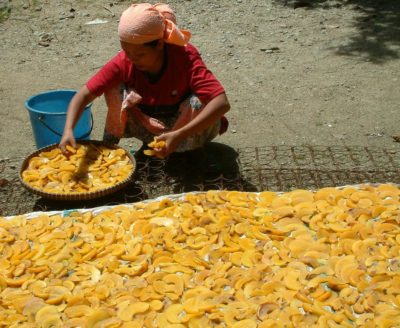
The fruits are firstly cleaned while the seeds and the fruits stalks are then removed. The rinds of the fruits are then thinly cut to facilitate the drying process. The slices are then sun-dried for about 2 to 3 days before being marketed as “asam keping”. [4]

Estimated cost of production
The estimated cost of production for a 20 year period is RM 52,000/ha. This cost covers the cost of land preparations, planting materials, planting and crop maintenance. For the total fresh yield of about 192,000 kg, the cost of production for a kilogram of fresh fruit is RM 0.30. The production cost was estimated based on the cost of current inputs during writing of this article. [4]
Chemical Constituent
G. atroviridis has been reported to contain citirc acid, tartaric acid, malic acid, ascorbic acid, hydrocitric acid, garcinia acid, 14-cis-docosenoic acid, succinic acid, pentadecanoic acid, octadecanoic acid, nonadecanoic acid and dodecanoic acid, and 1,1-dibutyl methyl hydroxycitrate. [5]
Plant Part Used
Fruit [1]
Traditional Use
The dries slices of the fruits are used commercially as a popular spice in curries, fish dressings and also as a sour relish. The young leaves have culinary uses and are used as a traditional vegetable. On the east coast of Peninsular Malaysia, fresh fish is steamed with the leaves of G. atroviridis to keep it fresh. In traditional medicine, G. atroviridis has been used as a postpartum medication and to remedy earache, dandruff, cough and stomach pains associated with pregnancy. [6]
Preclinical Data
Pharmacology
Antimicrobial activity
Antifungal activity
Two compounds isolated from the fruits of G. atroviridis showed selective inhibitory effect on the fungus Cladosporium herbarum. These two compounds are derivatives of garcinia acid – 2-(butoxycarbonylmethyl)-3-butoxycarbonyl-2-hydroxy-3-propanolide and 1,1-dibutyl methyl hydroxycitrate. [5]
Antibacterial activity
Two compounds isolated from the roots of G. atroviridis showed mild inhibition of Bacillus cereus and Staphylococcus aureus. These compounds are atrovirinone and atrovirisidone. [6] In a screening study of vegetable plants for their antimicrobial activities the ethanol extract of G. atroviridis showed inhibitory activities against two Gram-positive bacteria (Bacillus cereus and Bacillus megaterium), two Gram-negative bacteria (Escherichia coli and Pseudomonas aeruginosa). [7]
Antiobesity and lipid metabolism activity.
The availability of Hydroxycitric acid in the rind of the fruit of G. atroviridis has rendered it useful in the treatment of obesity and lipidaemic control. Hydroxycitric acid has been found to be a potent inhibitor of ATP citrate lyase which catalyses the extramitochondrial cleavage of citric acid to oxaloacetic acid and acetyl-CoA. The inhibition of this reaction reduces the availability of acetyl-CoA limiting fatty acid synthesis and lipogenesis during a lipogenic diet i.e. high carbohydrate diet. This shifts the conversion of calories from fat to glycogen. The increase glycogen production will stimulate glucoreceptors in the liver to send signals to the satiety center to suppress appetite and food cravings. It also signals beta oxidation burning stored body fat. [8][9]
The hydroxycitric acid and flavonoids contents of fruit of G. atroviridis have been reported to have hypolipidaemic property. A study of this effect in guinea pigs has shown that dietary addition of G. atroviridis reduces serum lipid level while at the same time reduces the fat deposition in the aorta of high cholesterol diet animals. [10]
Cytotoxic activity
Atrovirisidone B, a prenylated depsidone was isolated from the roots of G. atroviridis. This compound showed cytotoxic activity against human breast (MCF-7), human prostate (DU-145) and human lung (H-460) cancer cells. [11]
Anti-inflammatory activity
Atrovirinone, a benzoquinone was isolated from G. atroviridis was subjected to two cellular systems that could analyze its anti-inflammatory activities i.e. RAW 264.7 macrophage cells and whole blood. Atrovirinone inhibited the production of both nitric oxide and prostaglandin E2 from LPS-induced and IFN-gamma-induced RAW 264.7 cells and whole blood. Analysis of thromboxane B2 (TXB2) secretion from whole blood stimulated by either the cyclooxygenase (COX)-1 or the COX-2 pathway showed that atrovirinone inhibits the generation of TXB2 by both pathways and it was demonstrated that atrovirinone was more COX-2 selective in its inhibition of TXB2. Atrovirinone also inhibited the generation of intracellular reactive oxygen species and the secretion of TNF-alpha from RAW 264.7 cells. Lipoxygenase activity was also moderately inhibited by atrovirinone. This clearly shows that atrovirinone acts on important pro-inflammatory mediators by the inhibition of the nuclear factor-kappaB pathway and also by the inhibition of the COX/lipoxygenase enzyme activity. [12]
Toxicity
No documentation
Clinical Data
Clinical findings
Reduction of adipose tissue and body weight: effect of water soluble calcium hydroxycitrate in G. atroviridis on the short term treatment of obese women in Thailand. In this trial 50 obese women with BMI > 25 kg/m2 were randomly divided into two groups of 25. Group 1 was given water soluble calcium hydroxycitrate (HCA) as G. atroviridis while group 2 received a placebo. All were then given similar diet of 1000 Kcal/day. At the end of a two month period it was found that Group 1 loss more weight and at a faster rate than Group 2. This decrease in body weight was attributes to loss of fat storage as evidenced by decrease in triceps skin fold thickness. [13]
Precautions
No documentation
Interaction & Depletion
No documentation
Contraindications
No documentation
Poisonous Management
No documentation
Line Drawing
No documentation.
References
- Burkill IH. A dictionary of economic products of the Malay Peninsula Vol. 1. Kuala Lumpur: Governments of Malaysia and Singapore by the Ministry of Agriculture and cooperatives, 1966; p. 1064.
- Chooi OH. Rempah ratus: Khasiat makanan & ubatan. Kuala Lumpur: Utusan Publication & Distributor Sdn Bhd, 2008; p. 58.
- Multilingual Multiscript Plant Name Database. [homepage on the Internet]. Melbourne: University of Melbourne; c1995-2020 [updated 2010 May 15; cited 2009 Oct 12] Available from: http://www.plantnames.unimelb.edu.au/Sorting/Garcinia.html.
- Panduan penanaman asam gelugor. Kuala Lumpur: Jabatan Pertanian Semenanjung Malaysia; 2010.
- Mackeen MM, Ali AM, Lajis NH, Kawazu K, Kikuzaki H, Nakatani N. Antifungal garcinia acid esters from the fruits of Garcinia atroviridis. Z Naturforsch C. 2002;57(3-4):291-295.
- Sultana N, Alsarhan A, Al-Khatib A, Kadir M. Review on some Malaysian traditional medicinal plants with therapeutic properties. J Basic Appl Sci. 2014;10:149-159.
- Mackeen MM, Ali AM, El-Sharkawy SH, Manap MY, Salleh KM, Lajis NH, et al. Antimicrobial and cytotoxic properties of some Malaysian traditional vegetables (ulam). Int J Pharmacogn. 1997 1997;35(3):174-178.
- Jena BS, Jayaprakasha GK, Singh RP, Sakariah KK. Chemistry and biochemistry of (-)-hydroxycitric acid from Garcinia. J Agric Food Chem. 2002;50(1):10-22.
- Nurdjannah N, Bermawie N. 11 – Cloves A2 – Peter, K.V. Handbook of herbs and spices (Second edition): Woodhead Publishing; 2012. p. 197-215.
- Amran AA, Zaiton Z, Faizah O, Morat P. Effects of Garcinia atroviridis on serum profiles and atherosclerotic lesions in the aorta of guinea pigs fed a high cholesterol diet. Singapore Med J. 2009;50(3):295-299.
- Permanaa D, Abas F, Maulidiani, Shaari K, Stanslas J, Ali AM, Lajis NH. Atrovirisidone B, a new prenylated depsidone with cytotoxic property from the roots of Garcinia atroviridis. Z Naturforsch C. 2005;60(7-8):523-526.
- Syahida A, Israf DA, Permana D, Lajis NH, Khozirah S, Afiza AW, Khaizurin TA, Somchit MN, Sulaiman MR, Nasaruddin AA. Atrovirinone inhibits pro-inflammatory mediator release from murine macrophages and human whole blood. Immunol Cell Biol. 2006; 84(3): pp. 250-258.
- Roongpisuthipong C, Kantawan R, Roongpisuthipong W. Reduction of adipose tissue and body weight: effect of water soluble calcium hydroxycitrate in Garcinia atroviridis on the short term treatment of obese women in Thailand. Asia Pac J Clin Nutr. 2007;16(1):25.