

- One of the most important roles of plants in ethnobotany is their function as a source of food, which forms the most vital link between plants and people.
- Plants are a fundamental part of the diet of many ethnic groups across Peninsular Malaysia, Sabah, and Sarawak.
- In Malaysia, the indigenous group known as Orang Asli possesses profound knowledge and reverence for plant life, as well as for the nature and environment inherited from their ancestors. Indigenous communities like the Orang Asli, Iban, Melanau, Temuan, Kadazan-Dusun, and Bidayuh rely heavily on wild edible plants and cultivated species [1,2].
- As most of the ethnobotanical plants utilized are nearly identical between these two cultures, numerous traditional practices of Orang Asli have been embraced and modified by Malay communities over the centuries.
- Specifically, most plants are utilized for medicinal and therapeutic purposes, as well as for consumption, ceremonies, practical purposes, and aesthetic purposes.
Table 1: Common plant species that have value in the local Malay community [2].
| Species | Local Name |
| Malay plants for consumption | |
| Centella asiatica | Indian Pennywort or Pegaga |
| Piper betle | Piper betel / Sireh |
| Andrographis paniculata | King of bitter / Hempedu bumi |
| Eurycoma longifolia | Long jack /Tongkat Ali |
| Labisia pumila | Kacip Fatimah |
| Areca catechu | Betel Nut |
| Cinnamomum verum | Ceylon Cinnamon / Kayu manis |
| Curcuma xanthorriza | Temu lawak |
| Cymbopogon nardus | Citronella / Serai wangi |
| Morinda citrifolia | Cheese fruit / Mengkudu |
| Kaempferia galanga | Finger root |
| Polygonum minus | Kesum |
| Cosmos caudatus | King of salad or Ulam Raja |
| Oenanthe javanica | Water dropwort or Selom |
| Gynura precumbens | Scrambling gynura or Akar sebiak |
| Malay plants for rituals | |
| Citrus aurantifolia | Key limes / Limau nipis |
| Justicia gendarusa | Willow-leaved Justicia |
| Kalanchoe pinnata | Air plant, Life Plant, Miracle Leaf |
| Cordyline terminalis | Cordyline /Jenjuang |
| Malay plants for utilities | |
| Bambusa spp. | Bamboo (Eg: Buluh duri, Buluh minyak, Buluh gading, Buluh lemang) |
| Cocos nucifera | Coconut |
| Murraya paniculata | Orange jasmine |
| Bixa orellana | Lipstick tree |
| Aloe barbadensis | Aloe vera |
| Pandanus odoratissimus | Screwpine / Mengkuang |
| Pandanus amaryllifolius | Pandan |
| Daemonorops draco | Rattan |
| Musa sapientum | Banana |
| Acorus calamus L. | Calamus root, sweet flag |
| Hibiscus rosa sinensis | Hibiscus |
| Pogostemon cablin Benth. | Patchouli / Pokok Nilam |
| Aloe vera L. | Aloe vera |
| Jasminum sambac | Jasmines |
| Santalum album | Sandal Wood |
| Lawsonia inermis | Henna leaves |
Several research and documentation were identified to uncover plants that had been consumed by some of these ethnic groups in Malaysia based on our database.
- The Semai, a subgroup of the Orang Asli in Malaysia, particularly from three villages: Telimau, Bukit Terang, and Kampung Sat [3].
- Given the Orang Asli’s long-standing reliance on wild edibles for food, medicine, and building materials, such practices contribute to the preservation of their cultural heritage.
- Older Orang Asli women are considered to have greater knowledge than male elders or other community members in recognising wild edibles and their potential medicinal properties.
- A total of nine wild edible plants were identified, which are used both as food and in traditional medicine.
Table 2: Wild edible plants identified at Pos Sungai Telimau (T), Bukit Terang (BT), and Kampung Sat (KS) settlements [3].
| Local name | Scientific name | Vernacular name | Family name |
| Sayur manis (T) Pucuk manis (BT, KS) |
Sauropus androgynus (L.) Merr. | Malay Asin-asin Cekur manis Chekop Sayur manis Chinese Mani cai English Sweet leaf bush |
Phyllanthaceae |
| Pucuk ubi | Manihot esculenta Crantz | Malay Ubi gajah Ubi kayu English Cassava Manioc Tapioca |
Euphorbiaceae |
| Saya (T) Sayang (BT, KS) |
Diplazium esculentum (Retz.) Sw. | Malay Paku anjing Paku benar Paku besar Paku tanjung English Vegetable fern |
Athyriaceae |
| Rebung (T, BT) Rabo (KS) |
Dendrocalamus asper (Schult.) Backer | Malay Buluh betung Bambu petung English Giant bamboo |
Poaceae |
| Meranti (T, BT) Kera (KS) |
Solanum nigrum L. | Malay Terung meranti Terung para cicit Terung perat English Black nightshade Garden huckleberry |
Solanaceae |
| Pama (BT) Bern-go (KS) |
Gomphandra quadrifida (Blume) Sleumer | Malay Lambas Kayu kestari hutan Lempedu tanah jantan |
Stemonuraceae |
| Sendap (BT) Ber-negy (KS) |
Pleocnemia irregularis (C.presl) Holttum | Malay Paku siar |
Dryopteridaceae |
| Snegoh (KS) | Strobilanthes crispa Blume | Malay Pecah beling Jin batu Bayam karang Chinese Hei mian jiang Hun (black face general) English Yellow strobilanthus |
|
| Ber-pa (KS) | Erechittes valerianifolius (Link ex Spreng) DC. | Malay Pokok Sintrong English Tropical Burnweed |
Asteracea |
2. The Muruts community in Sabah, Malaysia; Keningau Murut, Timugon Murut, Paluan Murut, Kalabakan Murut and Tagal Murut [4].
- Sabah is home to 36 indigenous communities, with the Murut being the third largest with an estimated 91,700 people. They are dispersed throughout the districts of Kalabakan, Tenom, Nabawan/Pensiangan, and Keningau.
- Ethnic groups such as the Murut depend on the forest for their daily needs and for income. Produce such as wild vegetables, fruits and medicinal plants are gathered and sold in the weekly markets or ‘Tamu’ for an additional income.
- High-value plants, whether for medicinal purposes or other purposes, are gathered from the forest and frequently replanted in gardens or close to homes to provide a ready supply of raw materials. Hence, many such plants can be found within the community itself. For this reason, the community is home to many of these plants. However, a variety of other plants can be found along roadsides, in disturbed forests, or in nearby ladang (upland agricultural fields) and relatively undisturbed mixed dipterocarp forests.
- Wild plants have been used for food, building, household tools, and social and religious purposes for an equally long time.
- Remedies were typically administered by knowledgeable elders or traditional healers, often accompanied by rituals depending on the illness being treated. For the Murut, the river and the forest symbolise the world, providing clothing, food, medicine, and household supplies.
Table 3. Some of the useful plants that are consumed by the Muruts in Sabah, Malaysia [4].
| Scientific name | Common name | Category | Part used | Method of use |
| Mangifera indica L. | Longgom (Ka) | Edible fruit | Mesocarp | Eaten ripe, or unripe as pickle |
| M. pajang Kost. | Bambangan (Ka) | Edible fruit | Mesocarp | Eaten ripe |
| Bambusa blumeana Schult. | Kayawen (Ti) | Vegetable | New shoot | Cooked |
| Gigantochloa levis | Paling (Ti) | Vegetable cooking pot | New shoot internode | Cooked, cut |
| Schizostachyum brachycladum Kurz. | Bulu (Ti) | Dart’s tip | Internode | Cut |
| Durio graveolens Becc. | Ruyan (Ka) | Edible fruit | Aril | Eaten ripe |
| D. zibethinus Murray | Lampun (Ka) | Edible fruit | Aril | Eaten ripe |
| Poikilospermum suaveolens (BI.) Merr. | Bunatol (Ti) | Vegetable | Young leaves | Cooked |
| Baccaurea puberula Merr. | Tampoi kuning (Ka) | Edible fruit | Aril | Ripe |
| B. lanceolata (Miq.) Muell-Arg. | Lipasu (Ka) | Edible fruit | Aril & Mesocarp | Ripe aril Mesocarp eaten as pickle |
| Manihot esculenta Crantz. | Lui (Ka) | Edible | Root (tuber) Leaves |
Cooked |
| Curculigo latifolia Dryander. | Tambaka (Ta) | Edible fruit | Aril | Ripe |
| Zea mays L. | Halai (Ka) | Edible fruit | Cotyledons | Cooked |
| Garcinia parvifolia (Miq.) Miq. | Kandis (Ka) | Edible fruit | Aril & Mesocarp | Ripe aril Ripe mesocarp dried and cooked as vegetable |
| Litsea graciae Vidl. | Novolo (P) Pengoloban (Ta) |
Edible fruit | Aril | Ripe |
| Derris cf. trifolia Lour. | Apa (Ka) | Flavour | Leaves | Cooked |
| Lansium domesticum Corr. Serr. | Langsat (Ka & P) | Edible fruit | Aril | Ripe |
| Pycnarrhena cf. tumetacta Miers. | Apa (Ka) | Flavour | Leaves | Dried and added to cooking |
| Musa textiles Nee. | Punti (Ka) | Edible fruit Vegetable |
Aril Pith & un-opened flowers |
Ripe, Cook |
| Artocarpus communis J.R & G. Foster | Kemansi (Ka) | Edible fruit | Aril | Ripe |
| Psidium guajava L. | Kaliabas (P) Liabas (Ka) |
Edible fruit | Mesocarp | Raw/ripe |
| Embelia philippinensis A.DC. | Papaling (Ka) | Edible | Young leaves | Salad |
| Calamus spp. | Rotan lasun, pipit (Ka) | Vegetable | Tip of the plant | Cooked |
| Licuala spp. | Silan/Tanom (Ta) | Vegetable | Pith | Cooked |
| Meteroxylon sagu Rottb. | Lumbio (Ta) | Edible sago | Pith | Pressed |
| Oncosperma tigillarium | Nibong (Ka) | Vegetable | Tip | Raw or cook |
| Plectocomiopsis geminiflora (Griff.) Becc. | Ambarua (Ta) | Vegetable | Stem’s shoot | Cooked |
| Lepisanthes fruticosa (Roxb.) Leenh. | Talikasan (Ti) | Edible fruit | Aril | Ripe |
| Nephelium lappaceum L. | Kayakan (Ka) | Edible fruit | Aril | Ripe |
| N. ramboutan -ake (Labill.) Leenh. | Rumokot (Ka) | Edible fruit | Aril | Ripe |
| Solanum turvom Sw. | Lintahun (Ta) | Softener | Fruit | Cooked with meat |
| Polyporus umbellatus | Ongkulan (Ka) | Edible mushroom | – | Cooked |
| Auricularia auricula-judae | Tondungol (Ka) | Edible mushroom | – | Cooked |
| Sunsulit (Ka) | Edible mushroom | – | Cooked | |
| Nephrolepis biserrata (Sw.) Schoot. | Pakis (Ta) | Vegetable | Tip | Cooked |
3. The Dusun people reside in Tikolod Village, Tambunan District, Sabah, Malaysia [5].
- The research was conducted in Tikolod village, in Tambunan district of Sabah, Malaysia. The road distance from Kota Kinabalu city to the east of Sabah is about 90 km.
- A 2010 census by the Malaysian Department of Statistics found that there were roughly 30,529 Tambunan, with the Tambunan Dusun tribe making up the majority.
- They grow some hill paddy rice in hilly and mountainous regions but predominantly wet padi rice on the plain.
- Since the 1800s, the Tambunan people have made extensive use of bamboo resources, particularly “Poring” bamboo (Gigantochloa levis) in their daily lives.
- Tikolod village is almost entirely inhabited by Dusun people. Most of whom are Christians (Catholic), although some elders still practice pagan beliefs
- The villagers rely mainly on subsistence farming for livelihood, with most cultivating wet paddy rice alongside cash crops such as vegetables and ginger.
- Shifting cultivation is also practiced on nearby slopes, where forested areas are cleared, burned, and planted with hill paddy rice for several years.
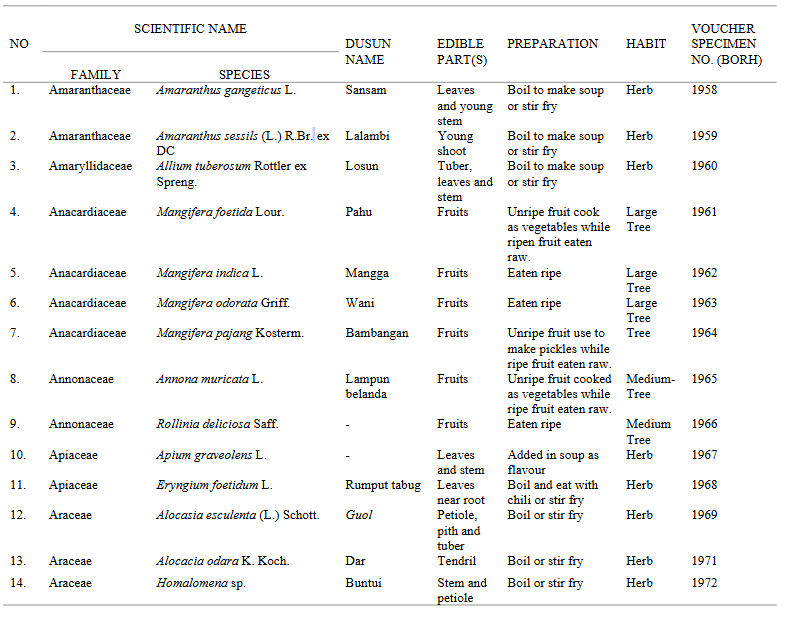
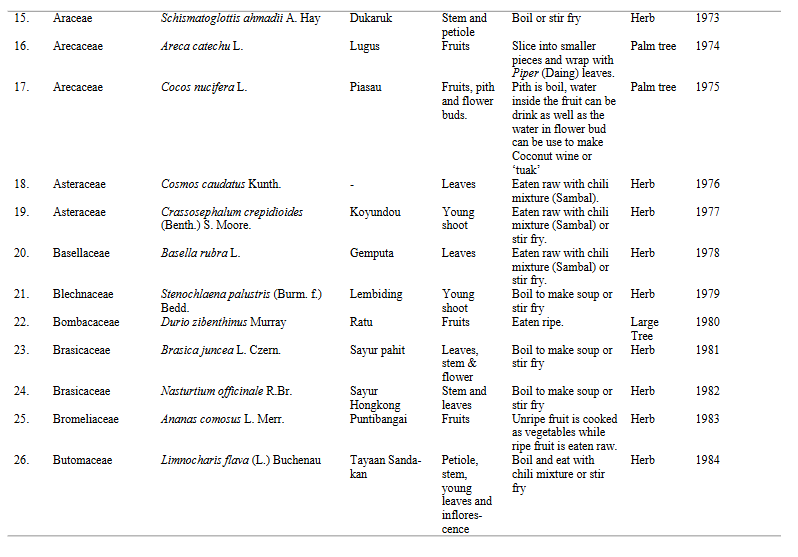
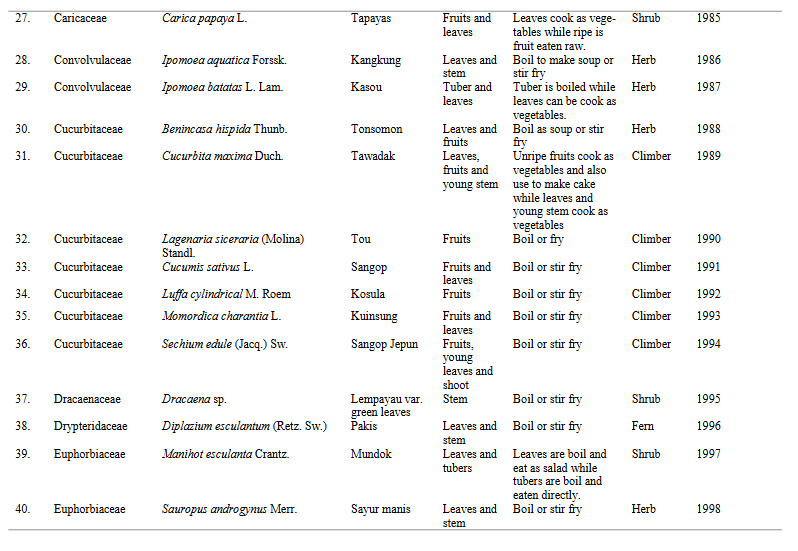
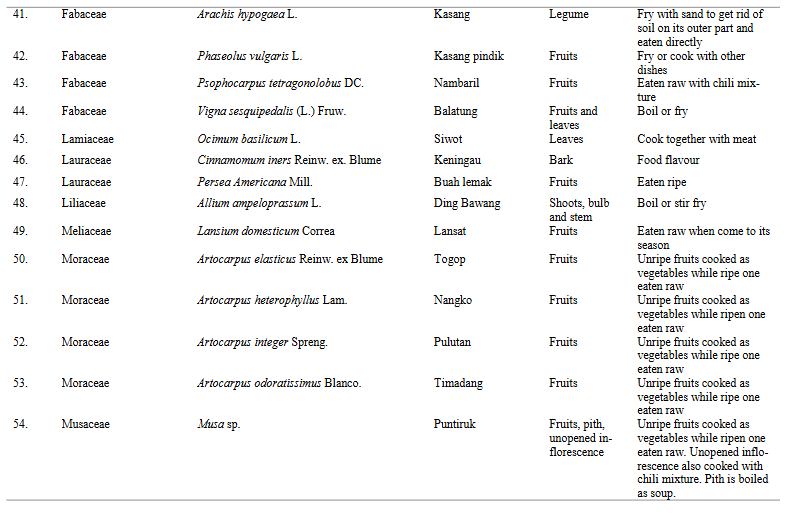
Table 4: List of edible plants in Tikolod village, Tambunan, Sabah, Malaysia [5].
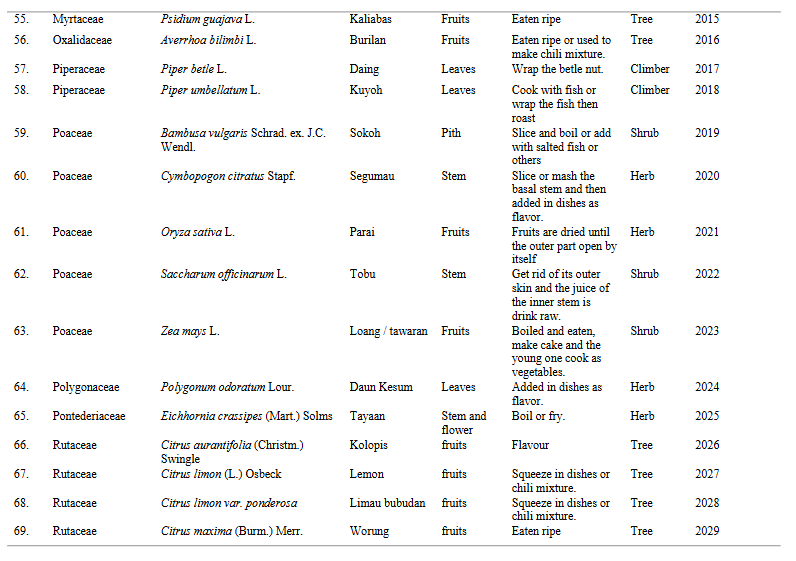
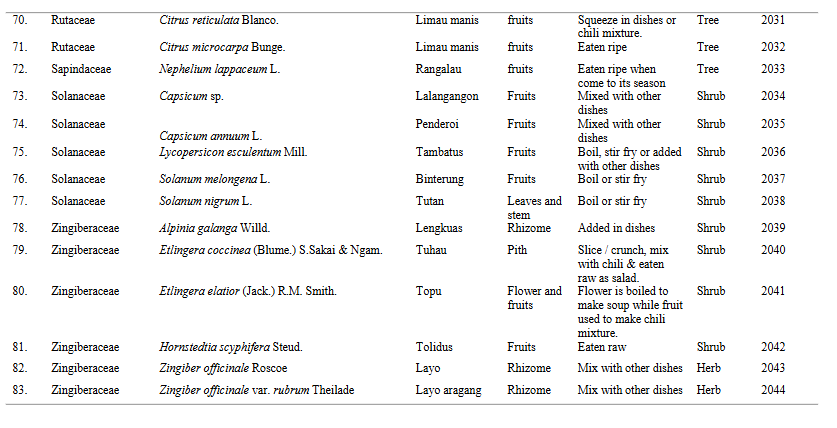
4. Among local communities in Bintulu, Sarawak, Malaysia [6].
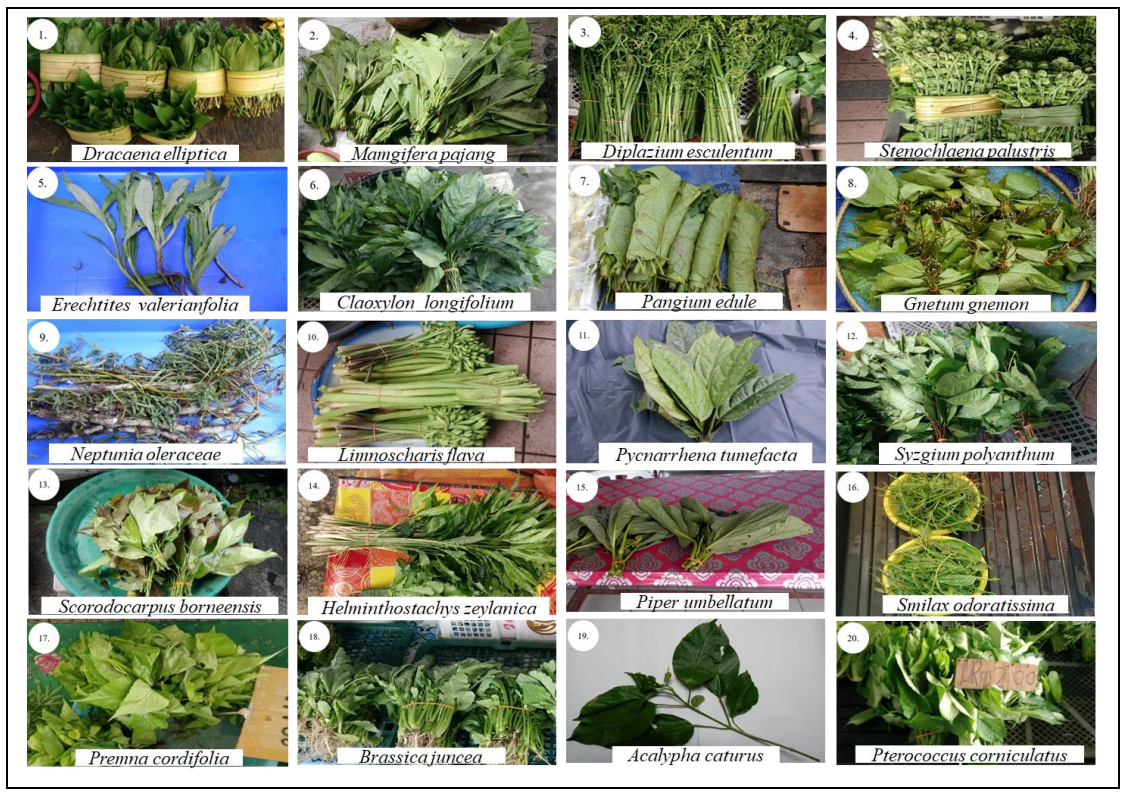
- A study was done to record the indigenous leafy vegetables (ILV) consumed by the local people, and mode of consumption of the ILV in Bintulu, Sarawak. In Malaysia, the ILV were consumed in various ways either eaten raw, cooked, fermented, blanched, or boiled and commonly included in a meal with rice, a staple food. Some of the ILV are very well known in the preparation of various traditional dishes.
- The study was conducted at three native markets in Bintulu, Tatau, and Sebauh where the locals commonly traded their harvested ILV.
- This study was participated by various ethnics with the highest percentage recorded by Iban communities (58.30%), followed by Malay (12.50%), Chinese (7.50%), Melanau (4.20%), Kenyah (5.80%), Bidayuh (4.20%), and other ethnics (7.50%).
Table 5. Lists of the ILV consumed by local people in Bintulu, Sarawak [6].
| Local name | Family | Species | Part used | Processing methods |
| Sepang | Euphorbiaceae | Acalypha caturus Blume | Shoots, leaves | The leaves used as fried vegetables together with anchovies |
| Ensabi Iban | Brassicaceae | Brassica juncea (L.) Czern var. Ensabi | Leaves, petioles | The leaves and petioles were fermented and served as ‘kimchi’ |
| Mandei | Euphorbiaceae | Claoxylon longifolium (Blume) Endl. | Leaves, bud | The young leaves chopped and cooked with coconut milk and anchovies |
| Paku | Athyriaceae | Diplazium esculentum (Retz.) Sw | Shoots, tender stem | The leaves and stem chopped and fried together with anchovies and shrimp paste |
| Sabong kekura | Agavaceae | Dracaena elliptica Thumb | Young leaves | Stir-fried together with anchovies and shrimp paste |
| Anak mambong | Compositae | Erechtites valerianifolia (Link ex Spreng) DC | Young leaves | Eaten raw as ‘salad’ or blanched like cassava paste |
| Sabong | Gnetaceae | Gnetum gnemon L | Leaves, petioles | Fried and mixed with other vegetables |
| Tongkat langit | Ophiglossaceae | Helminthostachys zeylanica (L.) Hook | Leaves, petiole, tender stem | Blanched and prepared as dishes called ‘kerabu’ and fried with shrimp paste |
| Jinjir | Limnocharitaceae | Limnocharis flava (L.) Buchena | Leaves, shoot, petiole | The leaves and petiole were chopped and fried with anchovies |
| Mawang | Anacardiaceae | Mangifera pajang Konsterman | Young leaves | The leaves were chopped and fried together with shrimp paste, chilli, and anchovies |
| Tangki | Leguminosae | Neptunia oleraceae Lour | Shoots, tender stem | Leaves and stem were chopped and cooked together with coconut milk |
| Kepayang | Flacourtiaceae | Pangium edule Reinw. | Leaves | The leaves soaked in the water a few days, boiled and fermented as ‘kasam’ |
| Burung | Piperaceae | Piper umbellatum (L.) Mi | Shoots, leaves | The leaves are cut and cooked as soup together with fish. The hair removed by crushed the leaves with hand in running water |
| Singkil | Verbenaceae | Premna cordifolia Roxb | Leaves | Leaves are stir-fried together with bamboo shoots |
| Daun nga | Euphorbiaceae | Pterococcus corniculatus (Sm.) Pax & H. Hoffm | Leaves, petiole | The leaves were fried with shrimp paste and other vegetables |
| Tubu | Menispermaceae | Pycnarrhena tumefacta Miers | Leaves | The leaves are added in the preparation of meat and fish dishes |
| Kesinduk | Olacaceae | Scorodocarpus borneenssis Becc | Leaves | The leaves used as a seasoning like garlic or fried with other vegetables |
| Kemudang | Smilacaceae | Smilax odoratissima Blume | Shoots, leaves | Leaves are chopped and fried with other vegetables |
| Midin | Blechnaceae | Stenochlaena palustris (Burm.f.) Bedd. | Shoots, tender stem | Stir-fried with anchovies and shrimp paste |
| Bungkang | Myrtaceae | Syzgium polyanthum (Wight) Walp. | Leaves | The fresh leaves used as ingredients in meat dishes and dried leaves used as a seasoning |
5. Among Sama-Bajau community in Kampung Taun Gusi, Kota Belud Sabah, Malaysia [7].
- A preliminary ethnobotanical survey of traditional salad food or ulam was conducted within the Sama–Bajau community in Kampung Taun Gusi, Kota Belud Sabah.
- Sama-Bajau people is the largest Muslim ethnic group in the state of Sabah; their population is approximately 477 000 people. Sama-Bajau people can be found up north of Sabah in Kudat, Kota Marudu, and Pitas, in Kota Belud, Tuaran, Kota Kinabalu, Putatan, and Papar.
- Since their traditional means of subsistence are agriculture and rice fields, they are referred to as inland Bajau. They are also renowned for being exceptional eastern riders.
- Kampung Taun Gusi is a village predominantly inhabited by the Sama-Bajau people, located in the Kota Belud District, a growing township on the west coast of Sabah.
Table 5: List of traditional salad foods (ulam) used by Sama-Bajau people of Kampung Taun Gusi, Kota Belud, Sabah [7].
| Family | Scientific name | Local name | Part used |
| Acanthaceae | Clinacanthus nutans | Belalai gajah | Leaves |
| Anarcardiaceae | Anacardium occidentale | Jagus | Young shoots |
| Annonaceae | Annona muricate | Durian belanda | Young leaves and fruits |
| Apiaceae | Centella asiatica | Pegaga | Leaves |
| Asphodelaceae | Aloe vera | Lidah buaya | Leaves (flesh & bud) |
| Asteraceae | Lactuca sativa | Daun salad | Leaves |
| Asteraceae | Cosmos caudatus | Ransa ransa/Ulam raja | Leaves |
| Asteraceae | Crassocephalum crepidioides | Tanduk manggarang/gipun | Leaves |
| Brassicaceae | Brassica oleracea | Kubis | Leaves |
| Convolvulaceae | Ipomoea aquatic | Kangkung | Leaves |
| Convolvulaceae | Ipomoea batatas | Ubi rambat | Young shoot/leaves |
| Cucurbitaceae | Cucumis sativus | Timun | Fruit |
| Cucurbitaceae | Benincasa hispada | Buah kundur | Young leaves and fruit |
| Caricaceae | Carica papaya | Betik/Kapayas | Young flower |
| Euphorbiaceae | Manihot esculenta | Ubi kayu | Young shoot |
| Fabaceae | Vigna unguiculate | Kacang panjang | Fruit |
| Lamiaceae | Ocimum basilicum | Daun bawing | Leaves |
| Lamiaceae | Orthosiphon stamineus | Misai kucing | Leaves |
| Malvaceae | Abelmoschus esculentus | Kacang bendi | Fruit |
| Moraceae | Artocarpus heterophyllus | Nangka | Young fruit |
| Musaceae | Musa paradasiaca | Pisang | Young flower |
| Pandanaceae | Pandanus amaryllifolius | Pandan wangi | Leaves |
| Passifloraceae | Passiflora foetida | Lapak lapak | Fruit |
| Solanaceae | Capsicum annuum | Lada padi | Young shoot, young fruit |
| Solanaceae | Solanum melongena | Terung | Fruit |
| Zingiberaceae | Curcuma caesia | Kunyit hitam | Young leaves |
| Zingiberaceae | Curcuma zanthorrhiza | Temu lawak | Young leaves |
| Zingiberaceae | Zingiber zerumbet | Lempoyang | Young leaves |
References:
- Sayok AK, Teucher U. Loss of food plants knowledge and identity among indigenous peoples in Malaysia. J Adv Res Soc Behav Sci. 2018;11(1):174–188.
- Adnan N, Othman N. The relationship between plants and the Malay culture. Procedia-Social and Behavioral Sciences. 2012 Jan 1; 42:231-41.
- Tharmabalan RT (2023) Identification of wild edible plants used by the Orang Asli, indigenous peoples of the Malay Peninsula. Front. Sustain. Food Syst. 7:1036490. doi: 10.3389/fsufs.2023.1036490
- Kulip J. An ethnobotanical survey of medicinal and other useful plants of Muruts in Sabah, Malaysia. Telopea. 2003 Jul 4;10(1):81-98.
- Kulip J. The ethnobotany of Dusun people in Tikolod village, Tambunan district, Sabah, Malaysia. Reinwardtia. 2014;14(1):101-21.
- Saupi N, Saidin AA, ZAKARIA MH, Sarbini SR, Yusli NA. An ethnobotanical study of indigenous leafy vegetables among local communities in Bintulu, Sarawak, Malaysia. Borneo Journal of Resource Science and Technology. 2020 Dec 31;10(2):155-65.
- Awang-Kanak F, Bakar MF, Mohamed M. Ethnobotanical survey on plants used as traditional salad food (ulam) in Kampung Taun Gusi, Kota Belud Sabah, Malaysia. InAIP conference proceedings 2018 Aug 15 (Vol. 2002, No. 1, p. 020024). AIP Publishing LLC.