

Cili padi Fruits
Capsicum frutescens L.
Solanaceae
Definition
Cili padi fruits consist of the powder of dried fruits of Capsicum frutescens L.(Solanaceae).
Synonym
Capsicum annuum var. frutescens (L.) Alef., Capsicum annuum var. minus (Fingerh.) Shinners, Capsicum assamicum J.Purkay. & Lok.Singh, Capsicum baccatum Vell., Capsicum baccatum var. pendulum (Willd.) Eshbaugh, Capsicum conoides Roem. & Schult., Capsicum conicum var. latifolium Dunal, Capsicum fastigiatum Blume, Capsicum frutescens var. frutescens L., Capsicum frutescens var. lanicaule Greenm., Capsicum frutescens var. minus Fingerh., Capsicum frutescens var. pendulum (Willd.) Besser, Capsicum indicum Dierb., Capsicum indicum subsp. elaeocarpon Dierb., Capsicum indicum var. pendulum (Willd.) Dierb., Capsicum indicum var. ribesium Dierb., Capsicum minimum Roxb., Capsicum pendulum Willd., Capsicum pendulum var. majus Dunal, Capsicum pendulum var. minus Fingerh. [1, 2].
Vernacular names
African chilli, African pepper, berry capsicum, bird’s eye chilies, bird pepper, burgoman pepper, bush red pepper, capsicum, Cayenne pepper, Chile pepper, chili pepper, chilli, chilli bean, foreign spice, goat pepper, green chilli, Guinea pepper, hot pepper, pepper, pili pili, red pepper, shrubby capsicum, spur pepper, tabasco, tabasco pepper, wild pepper (English); cabai burung, cabai rawit, cili, cili api, cili padi, chabai achong, chaboi seberang, chaboi selaseh, chili, chabai, lada merah, lada, lada kerawit (Malay); la jiao (Chinese); agi mirapa, ajadakumaricha, arukanam, arunamilakay, birik-man, brahu, brahumaricha, capoomologoo, mulaga (Indian) [3, 4, 5].
Character
| Colour | Ripe (red), unripe (green) |
| Odour | Pungent |
| Taste | Spicy, pungent |
Identification
Plant Morphology
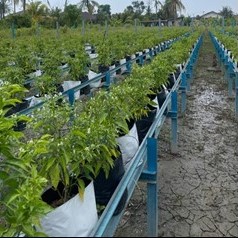
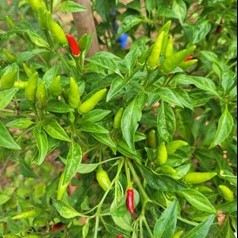
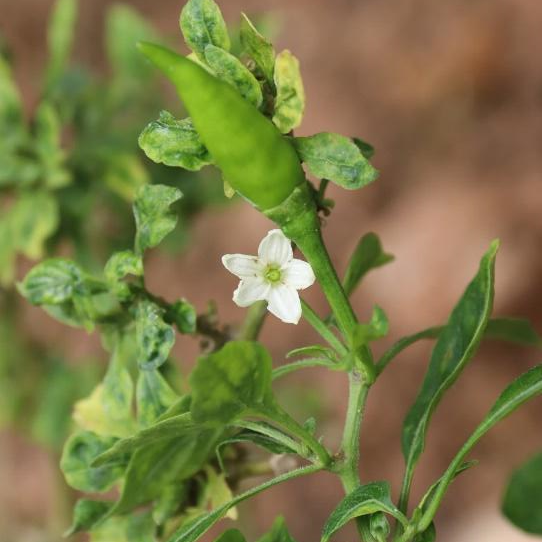
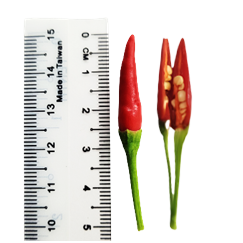
C. frutescens is a shrubby plant, 0.3‒1.4 m in height. Branches are slender which are 30‒120 cm long and usually have 1‒7 numbers. Stems are angular in shape, 1.5-2.5 cm in diameter, rarely pubescent, herbaceous, usually hollow and woody at the base and green in colour. Leaves are simple, alternately arranged, generally membranous, glabrous to very light pubescent, lanceolate, ovate and deltoid, margins are always entire, apex obtuse or acute to acuminate, often irregularly wrinkled. Inflorescence axillary, 4–13-flowered in inflorescences. Flower forms grown normally as paired or multiple pedicels at a node;corolla were greenish-white spots, ca. 0.25‒2 cm in diameter; petal length ca. 0.85‒1.3 cm; peduncle green, light purple to purple and erect at anthesis; pistil length ca. 0.5‒0.65 cm; stamen length ca. 0.36‒0.5 cm; filament colour green, light purple or purple. Fruit colourturns from dark green, green, greenish-white, yellowish-white, red and dark orange;length 1.5‒5.5 cm; width ca. 0.4‒1.2 cm; size ca. 0.6‒45 cm²; the apex of fruit shaped pointed, blunt or sunken. Seeds number per fruit ca. 10‒50; yellow to cream in colour; frequently have smooth waxy seedcoats with a conspicuous ridge around the hilum; hypocotyl is green or purple. [6,7,8]
Microscopy
Powdered material consists of endocarp cells with thick walls and straight pits, thin-walled parenchyma cells, thick-walled collenchyma cells, scattered numerous chromoplasts cells, oil globules, spiral and annular vessels, and calcium oxalate crystals.
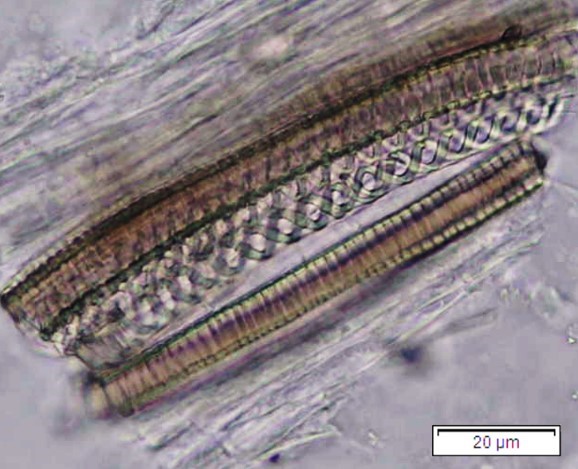
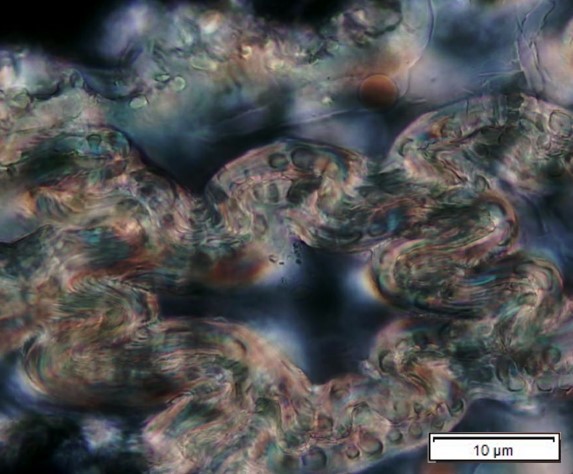
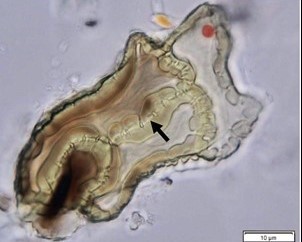
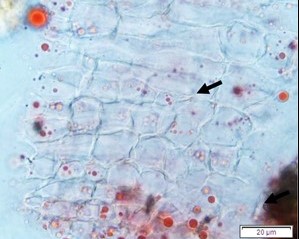
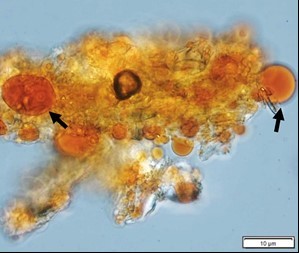
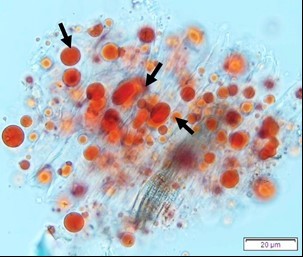
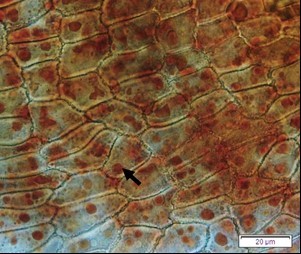
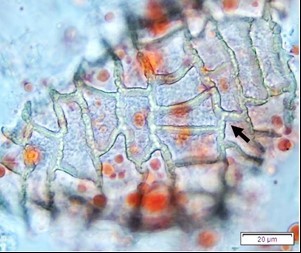
Figure 2 : Microscopic characters of Capsicum frutescens fruits powder of 0.355mm size (a) Endocarp cells with thick walls and straight pits (arrow) (magnification 40x); (b) thin-walled parenchyma cells (arrow) (magnification 20x); (c) thick-walled collenchyma cells (arrow) (magnification 2x); (d) & (e) scattered numerous chromoplasts in the cells (black arrow) (magnification 20x); (f) oil globules observed with Sudan red (III) (arrow)(magnification 40x); (g) spiral vessel (red arrow) and annular vessel (white arrow) (magnification 20x); (h) calcium oxalate (arrow) (magnification 40x). [Scale bars: a = 10 µm; b = 20 µm; c = 20 µm; d = 20 µm; e = 20 µm; f = 10 µm; g = 20 µm; h = 10 µm]
Chemical Tests
Observed colour of solution after treatment with various reagents:
| Test for the presence of triterpenes | Red colour |
| Test for the presence of steroids | Bluish-green |
| Test for the presence of saponins | Presence of stable foam |
Thin Layer Chromatography (TLC)
| Test Solutions | Weigh about 1 g of C. frutescens dried fruits powder in a conical flask with screw cap. Add 10 mL of acetonitrile to the flask. Using a water bath, extract the sample at 80°C for 4 hours with the cap closed (Note: Ensure the extract is submerged in water, avoiding direct contact with the bottom of the water bath). After extraction, cool the solution down to room temperature. Next, filter the solution and transfer it to a 30-mL vial. Concentrate the filtrate using a vacuum concentrator at 40°C until dryness. Dissolve the dried filtrate in 2 mL of methanol and use as test solution. |
| Standard solution | Dissolve capsaicin [CAS no.: 404-86-4] and dihydrocapsaicin [CAS no.: 19408-84-5] standards in methanol to produce standard concentration of 0.2 mg/mL. |
| Stationary Phase | HPTLC glass plate silica gel 60 F254, 10 x 10 cm |
| Mobile phase | Water : methanol; (20 : 80) (v/v) |
| Application | a) Capsaicin (S1) and dihydrocapsaicin (S2) standard; 5 μL, 8 mm as a band (b) Acetonitrile extract of C. frutescens dried fruit powder (L); 5 μL, 8 mm as a band |
| Development distance | 8cm |
| Drying | Air Drying |
| Detection | a) Visible light after derivatisation with 0.5% solution of 2,6-dibromoquinone-chlorimide in methanol and allowed to stand in a chamber containing ammonia fumes. b) UV at 280 nm after derivatisation with 0.5% solution of 2,6-dibromoquinone-chlorimide in methanol and allowed to stand in a chamber containing ammonia fumes. c)UV at 366 nm after derivatisation with 0.5% solution of 2,6-dibromoquinone-chlorimide in methanol and allowed to stand in a chamber containing ammonia fumes |

Figure 3 :HPTLC chromatogram of capsaicin (S1); dihydrocapsaicin (S2); acetonitrile extract of Capsicum frutescens dried fruits powder (L) observed under (a) visible light after derivatisation; (b) UV at 280 nm after derivatisation; and (c) UV at 366 nm after derivatisation.
High Performance Liquid Chromatography (HPLC)
| Test Solutions | Weigh about 1 g of C. frutescens dried fruits powder in a conical flask with screw cap. Add 10 mL of acetonitrile to the flask. Using a water bath, extract the sample at 80°C for 4 hours with the cap closed (Note: Ensure the extract is submerged in water, avoiding direct contact with the bottom of the water bath). After extraction, cool the solution down to room temperature. Next, filter the solution and transfer it to a 30-mL vial. Concentrate the filtrate using a vacuum concentrator at 40°C until dryness. Dissolve the dried filtrate in 2 mL of methanol and use as test solution. | ||||||||||||||||||||||||
| Standard solution | Dissolve capsaicin [CAS no.: 404-86-4] and dihydrocapsaicin [CAS no.: 19408-84-5] standards in methanol to produce standard concentration of 0.2 mg/mL. | ||||||||||||||||||||||||
| Chromatographic system |
Detector: UV 280 nm |
||||||||||||||||||||||||
| Mobile phase(gradient mode) |
|
||||||||||||||||||||||||
| System suitability requirements |
Perform at least five replicate injections of the standard solutions (0.2 mg/mL). The requirements of the system suitability parameters are as follow:
|
||||||||||||||||||||||||
| Acceptance criteria |
Retention time (tr) of capsaicin and dihydrocapsaicin standard in the test solution are similar to the tr of the standard solution.
|

(b)

(a)

Figure 5 :HPLC chromatogram highlighting the elution region of (a) capsaicin standard solution (0.2 mg/mL) at tr = 15.274 min; (b) dihydrocapsaicin standard solution (0.2 mg/mL) at tr = 16.498 min; and (c) acetonitrile extract of Capsicum frutescens dried fruits powder showing peak corresponding to capsaicin standard solution at tr = 15.280 min and dihydrocapsaicin standard solution at tr = 16.511 min.
(c)

(b)

(a)

Figure 4 :Whole HPLC chromatogram of (a) capsaicin standard solution (0.2 mg/mL) at tr = 15.274 min; (b) dihydrocapsaicin standard solution (0.2 mg/mL) at tr = 16.498 min; and (c) acetonitrile extract of Capsicum frutescens dried fruits powder showing peak corresponding to capsaicin standard solution at tr = 15.280 min and dihydrocapsaicin standard solution at tr = 16.511 min.
(c)

Figure 6:UV spectrum of acetonitrile extract of Capsicum frutescens dried fruits powder overlay with (a) capsaicin standard solution (0.2 mg/mL) and (b) dihydrocapsaicin standard solution (0.2 mg/mL).

Purity Test
The purity tests except foreign matter test are based on C. frutescens dried fruits powder of 0.355 mm particle size.
| Foreign Matter | |
| Not more than 9% |
| Loss on Drying | |
| Not more than 7% |
| Extraction Values | |
| Water-soluble extracts | |
| Hot Method | Not less than 25% |
| Cold Method | Not less than 19% |
| Ethanol-soluble extracts | |
| Hot Method | Not less than 10% |
| Cold Method | Not less than 7% |
Safety Test
| Heavy Metals | |
| Arsenic | Not More than 5.0 mg/kg |
| Mercury | Not More than 0.5 mg/kg |
| Lead | Not More than 10.0 mg/kg |
| Cadmium | Not More than 0.3 mg/kg |
| Specific Pathogens | |
| Salmonella spp. | Absent in 25g |
| Escherichia coli | Absent in 1 g |
| Staphylococcus aureus | Absent in 1 g |
| Pseudomonas aeruginosa | Absent in 1 g |
Chemical Constituents
Ethanol extract of C. frutescens dried fruit was found to contain alkaloids (e.g., capsaicinoids (capsaicin, dihydrocapsaicin, nordihydrocapsaicin, I-dihydrocapsaicin, and homodihydrocapsaicin)), phenolics (e.g., gallic acid, 3,4-dihydroxybenzoic acid, catechin, vanillin, benzoic acid, salicylic acid, and luteolin), carotenoids, and vitamin (e.g., ascorbic acid) [9].
Acetonitrile extract of C. frutescens dried fruit was found to contain alkaloids (e.g., capsaicin and dihydrocapsaicin) and flavonoid (e.g., chrysoeriol) [10].
Acetone extract of C. frutescens dried fruit was found to contain alkaloids (e.g., capsaicinoids (nornorcapsaicin, nornordihydrocapsaicin, norcapsaicin, nordihydrocapsaicin, capsaicin, dihydrocapsaicin, homocapsaicin, and homodihydrocapsaicin)), carotenoids (e.g., phytoene, zeaxanthin, antheraxanthin, capsanthin, cis-capsanthin, cryptocapsin, cryptoxanthin-5,6-epoxide, β-cryptoxanthin, β-carotene-5,6-epoxide, zeaxanthin, and antheraxanthin) [11,12,13].
Dicholoromethane extract of C. frutescens dried fruit was found to contain alkaloids (e.g., capsaicinoids (capsaicin, dihydrocapsaicin, nordihydrocapsaicin, and homocapsaicin) [14].
Ethyl ether extract of C. frutescens dried fruit was found to contain alkaloids (e.g., capsaicinoids (capsaicin, dihydrocapsaicin, nordihydrocapsaicin, and homocapsaicin) [14].
Hexane extract of C. frutescens dried fruit was found to contain alkaloids (e.g., capsaicinoids (capsaicin, dihydrocapsaicin, nordihydrocapsaicin, and homocapsaicin) [14].
Medicinal Uses
Uses described in folk medicine, not supported by experimental or clinical data
Traditionally, the fruits of C. frutescens have been used for their carminative, spicy, and irritant properties. They also serve as an agent to relieve spasms, stimulate the body, combat microbes, reduce fever, promote sweating, aid digestion, and act as an antiseptic and tonic for the stomach. Externally, they are applied as a skin-redness inducer, a remedy for rheumatism, a counteractive irritant, and an antiseptic [15].
In Ayurvedic practice, the leaves and fruits are used as febrifuges, vermifuges, painkillers, and for their general healing effects [16].
Biological and pharmacological activities supported by experimental data
Antioxidant activity
Ethanol extract of C. frutescens showed antioxidant activity with IC50 of 423.07 ± 8.41 µg/mL compared to ascorbic acid at IC50 of 98.56 ± 0.75 μg/mL using DPPH radical scavenging activity [17].
Anti-inflammatory
Ethyl acetate extract of C. frutescens administered intraperitoneally (2.5 mg/kg body weight) reduced the oedema in both female and male adult rats (250–300 g body weight) with circumference measurement of 7.20 ± 0.31 cm in 32 hours compared to the capsaicin (2.5 mg/kg; 6.10 ± 0.35 cm) and diclofenac (100 mg/kg; 7.20 ± 0.19 cm) [18].
Antimicrobial activity
The n-hexane extract of C. frutescens seeds showed inhibition activity against E. coli (10 mm), Pseudomonas aeruginosa (14 mm), Klebsiella pneumoneae (12 mm), Staphylococcus aureus (14 mm), and Candida krusei (12 mm), compared to the ciprofloxacin (5 μg/mL) with inhibition zone ranging from 6 mm to 11 mm, using the well diffusion method [19].
Anti-malarial activity
Methanolic extract (80%) of C. frutescens dried fruit (100, 200, 400 mg/kg) significantly reduced (p < 0.05) the parasite load of the tested mice infected with Plasmodium berghei compared to vehicle control (Tween 80, 2% v/v). The highest parasitaemia inhibition (93.28%) was observed for the mice group fed with 400 mg/kg/day of C. frutescens crude extract [20].
Antidiabetic effect
Acetone extract of C. frutescens fruits (250 and 500 mg/kg) was administered orally to streptozotocin-induced diabetic male and female Wistar rats (150–200 g, with blood glucose level more than 200 mg/dL) for a duration of 21 days. The extract significantly reduced serum glucose level to 105.67 ± 4.98 mg/dL (p < 0.01) and 98.66 ± 4.27 mg/dL (p<0.001) at respective concentration compared to glibenclamide (5 mg/kg) treated group (97.67 ± 2.59 mg/dL) [21].
Clinical studies
Information and data have not been established.
Safety Information
Preclinical studies (Toxicology study)
Acute toxicity
Methanolic extract (80%) of C. frutescens dried fruit powder (2,000 mg/kg) administered once orally to Swiss albino mice (25–31 g) showed no signs of acute toxicity and mortality within 14 days of observation [20].
Others (Adverse reaction, contraindication, side effect, warning, precaution)
Information and data have not been established.
Dosage
Information and data have not been established.
Storage
Store below 30°C. Protect from light and moisture.
Reference
- World Flora Online [Internet]. Capsicum frutescens L.; [cited on 19 November 2024]. Available from: https://wfoplantlist.org/taxon/wfo-0001020090-2023-12?page=1
- Plants of the World Online [Internet]. Capsicum frutescens L.; [cited on 15th May 2023]. Available from: https://powo.science.kew.org/taxon/urn:lsid:ipni.org:names:316959-2
- Umberto Quattrocchi, F.L.S. CRC world of dictionary of medicinals and poisonous plants. Volume 2 C–D. CRC Press. 2012; p.96–97.
- Malaysia Biodiversity Information System (MyBIS) [Internet] Capsicum frutescens; [cited on 19 November 2024]. Available from: https://www.mybis.gov.my/sp/15198.
- Flowers of India [Internet]. Chilli – Capsicum frutescens; [cited on 20 November 2024]. Available from: https://www.flowersofindia.net/catalog/slides/Bird%20Chilli.html
- Symon, D. E. The Solanaceae of New Guinea. Journal of the Adelaide Botanic Garden. 1985; 8, 1–171.
- Smith, P. G., & Heiser, C. B. Taxonomic and Genetic Studies on the Cultivated Peppers, Capsicum annuum L. and C. frutescens L. American Journal of Botany. 1951; 38(5), 362–368.
- Sota, Y. & Eiji, N. Morphological characters and numerical taxonomic study of Capsicum frutescens in Southeast and East Asia. Tropics. 2004; 14(1), 111–121.
- Sumate B, Chada P, Muenduen P. Ultrasound-assisted extraction of capsaicinoids from Capsicum frutescens on a lab- and pilot-plant scale. Ultrasonics Sonochemistry. 2008;15(6):1075–1079.
- Nascimento PLA, Nascimento TCES, Ramos NSM, Silva GR, Gomes JEG, Falcão REA, Moreira KA, Porto ALF, Silva TMS. Quantification, antioxidant and antimicrobial activity of phenolics isolated from different extracts of Capsicum frutescens (pimenta malagueta). Molecules. 2014;19(4):5434–5447.
- Zhuang Y, Chen L, Sun L, Cao J. Bioactive characteristics and antioxidant activities of nine peppers. Journal of Functional Food. 2012;4(1):331–338.
- Ute S, Reinhold C, Andreas S. Characterization of major and minor capsaicinoids and related compounds in chili pods (Capsicum frutescens L.) by high-performance liquid chromatography/atmospheric pressure chemical ionization mass spectrometry. Analytica Chimica Acta. 2006;557(1–2):236–244.
- Giuffrida D, Dugo P, Torre G, Bignardi C, Cavazza A, Corradini C, Dugo G. Characterization of 12 capsicum varieties by evaluation of their carotenoid profile and pungency determination. Food Chemistry. 2013;140(4):794–802.
- Santos P, Aguiar AC, Barbero GF, Rezende CA, Martínez J. Supercritical carbon dioxide extraction of capsaicinoids from malagueta pepper (Capsicum frutescens L.) assisted by ultrasound. Ultrasonics Sonochemistry. 2015; 22:78–88.
- Quattrocchi U. CRC World Dictionary of Medicinal and poisonous plants: Common names, scientific names, eponyms, synonyms, and etymology. Boca Raton, FL: CRC, Taylor & Francis Group; 2012.
- Ayurvedic medicinal plants of Sri Lanka: Compendium Version 3 [Internet]. Capsicum frutescens L. [cited on 19 November 2024]. Available from http://www.instituteofayurveda.org/plants/plants_detail.php?i=1251&s=Scientific_name
- Rahman MA, Akter S, Jamal MAH, Pandith H, Haque MA. Comparative assessment on in vitro antioxidant activities of ethanol extracts of Averrhoa bilimbi, Gymnema sylvestre and Capsicum frutescens. Pharmacognosy Research. 2014;6(1),36–41.
- Jolayemi AT, Ojewole JA. Anti-inflammatory and analgesic effects of capsaicin and ethyl-acetate extract of Capsicum frutescens Linn (Solanaceae) in rats. African Health Sciences. 2013;13(2):357–361.
- Gurnani N, Gupta M, Mehta D, Mehta BK. Chemical composition, total phenolic and flavonoid contents, and in vitro antimicrobial and antioxidant activities of crude extracts from red chilli seeds (Capsicum frutescens L.). Journal of Taibah University for Science. 2016;10(4):462–470.
- Habte G, Assefa, S. In vivo antimalarial activity of crude fruit extract of Capsicum frutescens var. minima (Solanaceae) against Plasmodium berghei-infected mice. BioMed Research International. 2020:1320952.
- Maya MR, Ananthi V, Arun ASenthil Kumar P, Govarthanan M, Rameshkumar K, Veeramanikandan V, Balaji P. Protective efficacy of Capsicum frutescens fruits in pancreatic, hepatic and renal cell injury and their attenuation of oxidative stress in diabetic Wistar rats. Journal of Taibah University for Science. 2021;15(1):1232–1243.