

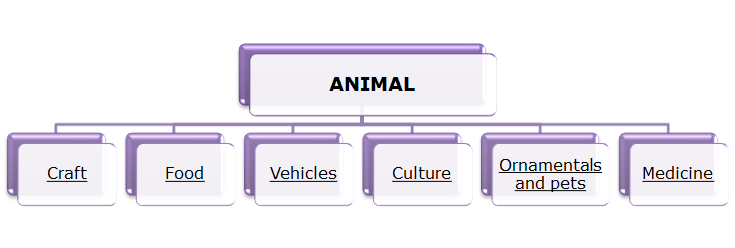
Malaysia, despite covering only ~0.2% of the Earth’s land area, is a megadiverse country with tens of thousands of animal species recorded in terrestrial and marine ecosystems. The country’s rich faunal diversity has long been intertwined with the traditions, economies, and belief systems of its multi-ethnic and indigenous communities. Animals can be use as various purposes as (shown in Table 1) for food, vehicles, uses in our culture, in craft, as ornamentals and pets, as well as used as medicine.
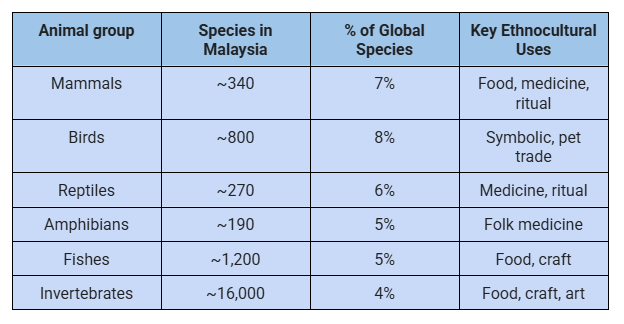
- Table 1 shows the diversity of animals found in Malaysia compared to worldwide. Although Malaysia had a very small landmass, that is 0.2% of global landmass, it was very rich in faunal diversity.
- Thus, it is expected that animals had been associated with the life of the ethnics and indigenous people since time immemorial.
- In these articles, a description of how particular animals are being used by certain ethnics of Malaysia will be narrated, especially ethnic in Sabah and Sarawak.
- Animals serve as a direct source of protein and domesticated animals are hunted or reared for their meat or other edible parts. For example, in one study in Sarawak, 44% of local wildlife use was for food (1).
- Animals have been historically used and continue to be used for traction, hauling, ploughing, and as transport in areas where mechanisation is limited. For example, buffaloes in Southeast Asia haul carts, pull ploughs in paddy fields, and work in flooded soils (2).
- Animals play a role in cultural identity, ritual, ceremonial, mythological and symbolical systems. They may be totems, sacrificial animals, or integrated into festivals and traditional practices. In Malaysia, for example, animals are used in ritual sacrifices and in social exchanges (3).
- Animals parts (skin, bones, feathers, shells, tusks) or whole animals may be used to make tools, crafts, ornaments or decorative items. This may involve traditional craftwork, jewelry, carvings, musical instruments, etc.(4).
- Animal are kept for companionship, display, status or aesthetic values rather than utilitarian production. Pets and ornamental animals reflect human-animal relationships beyond food or labor. While specific ethnographic detail for Malaysia is less documented in these terms, the usage of animals as pets is noted in ethnozoological surveys (5).
- Animals and animal products are used in traditional medicine (zootherapy) for treating ailments, healing wounds, as tonics, etc. Many cultures record dozens or hundreds of animal species used. For example, in India and elsewhere, animals and their parts serve as ingredients in indigenous healing (6).
Reference
- Kendie, F. A., Mekuriaw, S. A., & Dagnew, M. A. (2018). Ethnozoological study of traditional medicinal appreciation of animals and their products among the indigenous people of Metema Woreda, North-Western Ethiopia. Journal of Ethnobiology and Ethnomedicine, 14(1), 37.
- Pearson, R. A. (2021). The Use of Draught Animals in Rural Labour. Animals, 11(9), 2683.
- Allied Academies. (n.d.). Ethnozoology: The intersection of culture and animal knowledge. Journal of Anthropology & Ecology, [article].
- Padmanabhan, P. (2019). Ethnozoology, ethnobiology, traditional knowledge, indigenous communities and biodiversity conservation. International Journal of Advanced Research, 7(4), 310-325.
- Kendie, F. A., Mekuriaw, S. A., & Dagnew, M. A. (2018). Ethnozoological study of traditional medicinal appreciation of animals and their products. Journal of Ethnobiology and Ethnomedicine, 14(1), 37.
- Altaf, M., Umair, M., Abbasi, A. R., & Muhammad, N. (2018). Ethnomedicinal applications of animal species by the local communities of Punjab, Pakistan. Journal of Ethnobiology and Ethnomedicine, 14(1), 55.