

Elephantopus scaber
Family
Compositae
Synonyms
None
Vernacular Names
| Malaysia | Tutup bumi, tapak leman (Peninsular), pepalut (Sabah). |
| English | Prickly-leaved elephant’s foot |
| Indonesia | Tapak liman, tutup bumi (General), talpak tana (Madurese). |
| Philippines | Dila-dila, tabatabakohan (Tagalog), kabkabron (Iloko). |
| Thailand | Do mairuu lom (central), kee fai nok khuun (Loei), naat me khlaen (Surat Thani). |
| Vietnam | C[us]c chi thi[ee]n, c[or] l[uw] [owx]i m[ef]o, dia d[ar]m th[ar]o. |
Geographical Distributions
It is widespread in tropical America, Africa, Asia and Australia; throughout South-East Asia.
Description
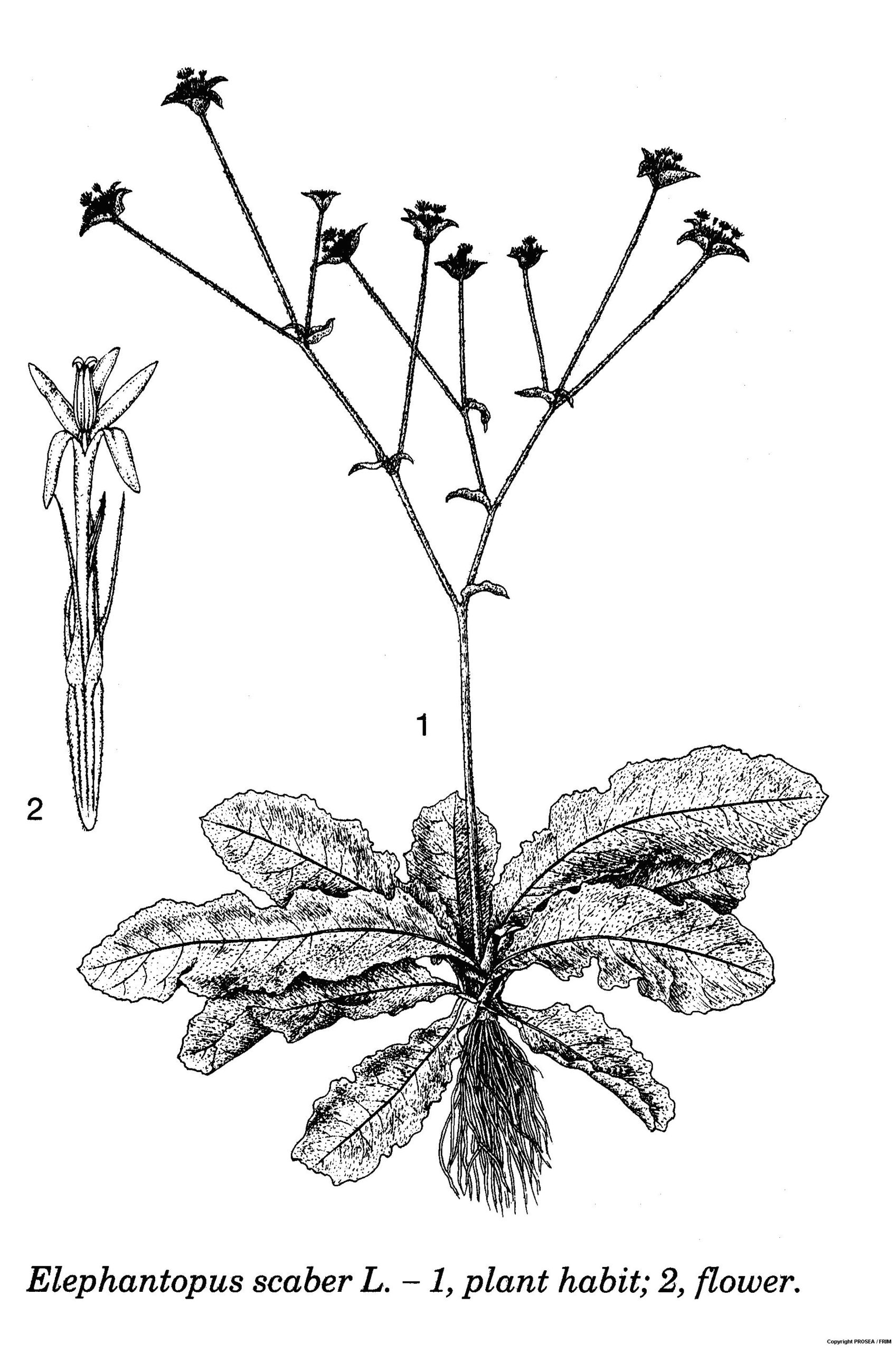
It is an erect herb up to 80 cm tall with rigid stems lying flat, longhaired or rough to touch.
The leaves are in a radical rosette, if the stem is much smaller. The leaves are oblong-reverse egg-shaped to spoon-like with size 5-38 cm x 1-6 cm. It has condensed head of almost sessile flowers in terminal and generally long-stalk. The condensed head of sessile flower bracts are generally longer than the ring of bracts.
The flower petals are 7-9 mm long, bluish or purplish but sometimes white.
The fruit is about 4 mm long with various tufts of equal hairs on fruits bristles 4-6 mm long.
Ecology / Cultivation
E. scaber occurs in grasslands, wasteland, roadsides, along fields and in forest borders, up to 1500 m altitude.
Line Drawing / Photograph
Read More
1) Safety
References
-
Plant Resources of South-East Asia No 12(1): Medicinal and poisonous plants 1.