

Ailanthus triphysa (Dennst.) Alston
Family
Simaroubaceae
Synonyms
Ailanthus malabarica DC., Ailanthus imberbiflora F. Muell, Ailanthus philippinensis Merr.
Vernacular Names
|
English |
White siris. |
|
Indonesia |
Kayu langit (General), ki pahit (Sundanese), kirontasi (Sulawesi). |
|
Philippines |
Malakamias (General), kalauag (Bikol). |
|
Myanmar |
O-dein. |
|
Thailand |
Makkom (Northern), mayom-pa (Central), mayom-hom (South-eastern). |
|
Vietnam |
B[us]t, c[af]ng hom th[ow]m. |
Geographical Distributions
Ailanthus triphysa is distributed in India, Sri Lanka, Burma (Myanmar), Indo-China, southern China, Thailand, Peninsular Malaysia, Java, Borneo (Sabah, East Kalimantan), Sulawesi, the Philippines, and northern Australia (Queensland and northern New South Wales). It is planted in the arid zones of Africa.
Description
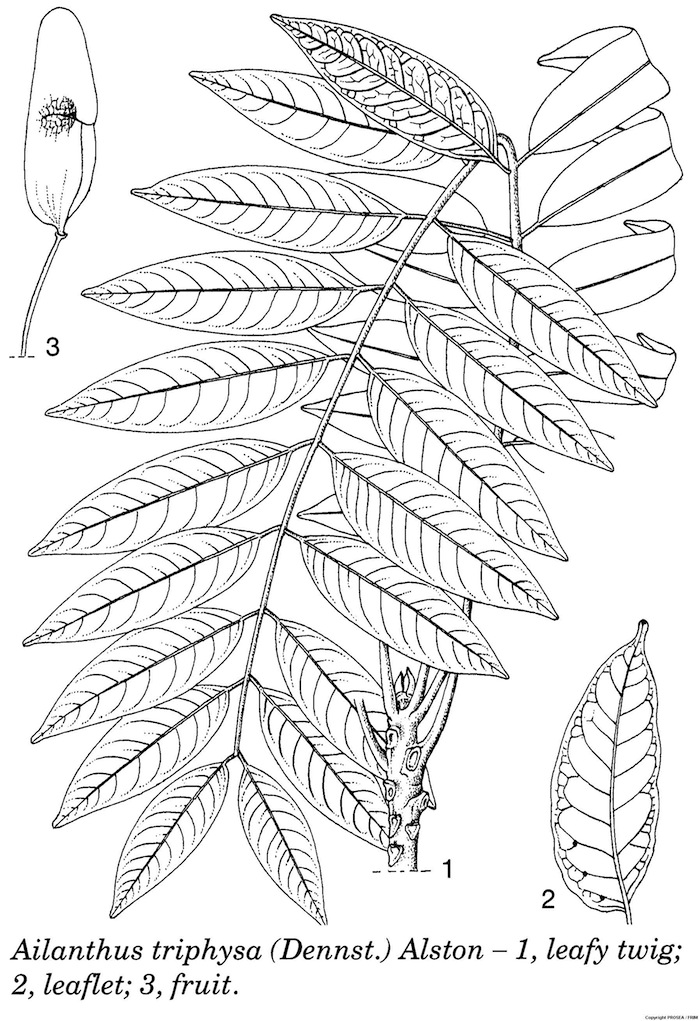
Ailanthus triphysa is a large tree that can reach up to 45 m tall and with dimpled bark.
The leaves are paripinnate with 6-17(-30) pairs of entire leaflets, measures (5-)9-15(-26) cm long, covered with velvety hairs below and with many glands scattered over the lower surface.
The petals are hairless while there are (2-)3(-4) hairless carpels.
Its fruit is 4.5-8 cm long.
Ecology / Cultivation
Ailanthus triphysa is comparatively rare and occurs in evergreen and seasonal forests up to 600 m altitude.
Line Drawing / Photograph
References
- Plant Resources of South-East Asia No.12(2): Medicinal and poisonous plants 2.