

Dendrolobium triangulare (Retz.) Schindler
Family
Leguminosae
Synonyms
Hedysarum triangulare Retz., Desmodium cephalotes (Roxb.) Wight & Arn., Desmodium triangulare (Retz.) Merr. s.s.
Vernacular Names
|
Thailand |
Kraduuk ueng (Central), luuk prakham phee (South-eastern), naa nuan, nieo maa (Peninsular). |
|
Vietnam |
Ba ch[ex], ni[eex]ng d[uwj]c, d[aaj]u b[aj]c d[aaf]u. |
Geographical Distributions
Dendrolobium triangulare is distributed from tropical Africa, eastward to India, Sri Lanka, Burma (Myanmar), southern China, Taiwan, Indo-China, Thailand, Malaysia and Indonesia (Kalimantan, Sulawesi, Java, Madura, Lesser Sunda Islands, Timor).
Description
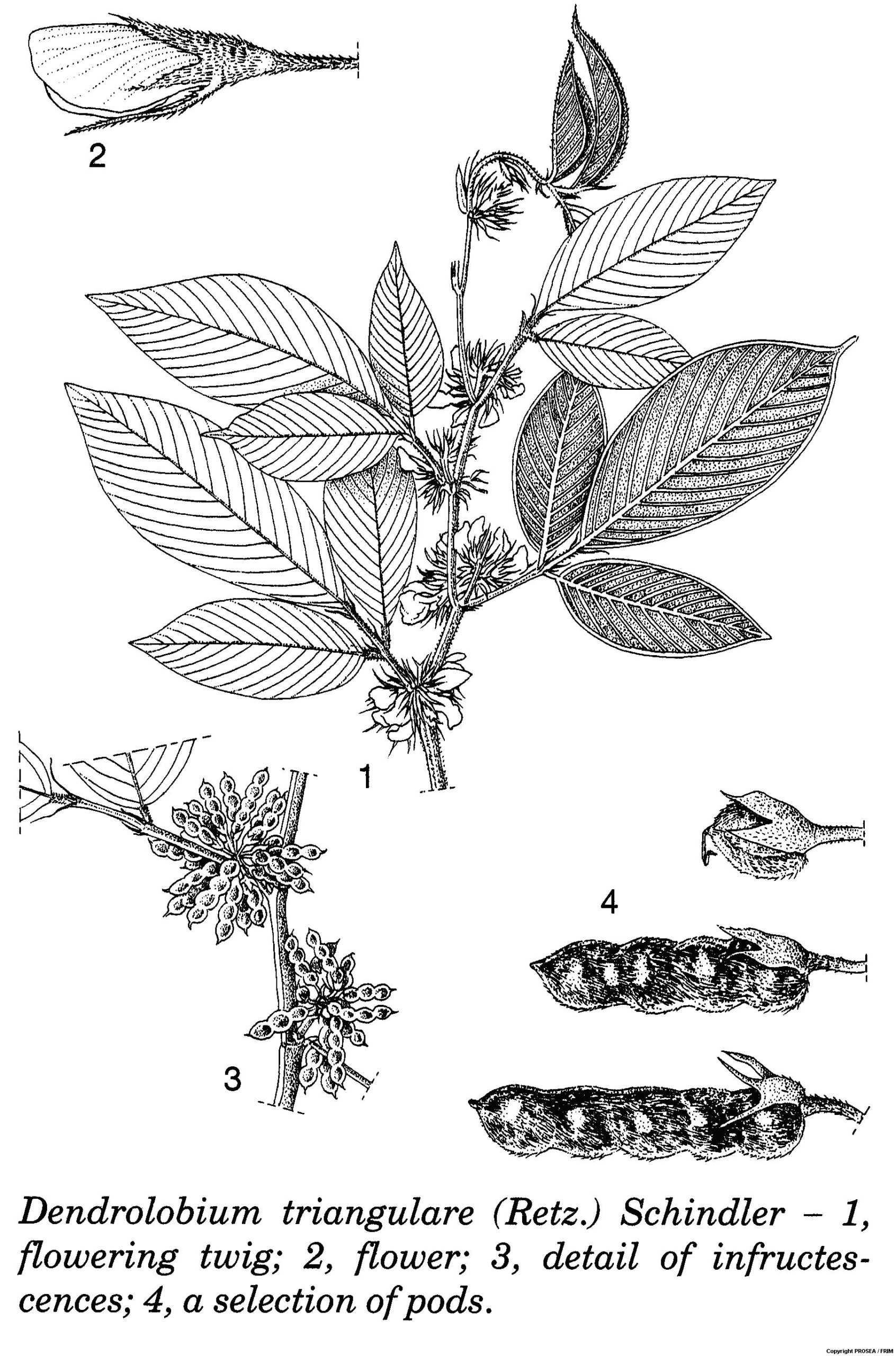
Dendrolobium triangulare is a branched shrub that can reach up to 2 m tall. The branches are terete, lenticellate, striate and nearly hairless. The young parts are sharply triangular.
The leaves are 3-foliolate, with 1.5-6 cm long petiole, occasionally persistent stipules, ovate or elliptical leaflets, wedge-shaped and acute or oblong at base, acuminate at apex and entire or slightly undulate. The upper surface is variably sericeous when young while the lower surface is sericeous. The terminal leaflet measures 7-15 cm x 3-6 cm while the lateral leaflet measures (2-)6-9(-11) cm x (0.7-)2-4(-5) cm.
The inflorescence is with peduncle, which is less than 1 cm long and 20-30-flowered. The primary bracts measure 2-4 mm x 0.5-1.5 mm. The sepal is 5-9 mm long with white or yellowish petal, standard suborbicular or broadly elliptical and elliptical wings. The keel petals are smaller than the wings, with 8-12 mm long androecium, 7-15 mm long gynoecium and densely pubescent ovary.
The pod is sessile and compressed. It is (1-)3-5(-6)-jointed which is swollen at the seeds, variably appressed-sericeous where the lower suture is more deeply undulate than the upper. Both sutures are variably thickened. The constricted pod in outline is broadly oblong-elliptical or quadrate, measures 4 mm x 3-4 mm and not reticulate.
Ecology / Cultivation
Dendrolobium triangulare is found on a wide range of soils from marshy to dry sandy conditions, in forest margins, roadsides, secondary growths, and from 50-1500 m altitude.
Line Drawing / Photograph
References
- Plant Resources of South-East Asia No.12(2): Medicinal and poisonous plants 2.