

Donax canniformis (G. Forster) K. Schumann
Family
Marantaceae
Synonyms
Thalia canniformis G. Forster, Donax arundastrum Loureiro, D. grandis (Miq.) Ridley, Donax cannaeformis (G. Forster) Rolfe, Donax parviflorum Ridley.
Vernacular Names
|
Malaysia |
Bemban, bemban ayer, buluh leck (Kelabit). |
|
Brunei |
Bamban, bamban batu |
|
Indonesia |
Bamban (Malay, Javanese, Sundanese), bangban (Sundanese), moa (Moluccas). |
|
Philippines |
Bamban, banban (Tagalog, Ilokano, Bisaya, Manobo, Sulu, Bukidnon). |
|
Cambodia |
Daem run. |
|
Thailand |
Klah, blah, klum (Central, Surat Thani, Trat). |
|
Vietnam |
Dong s[aaj]y. |
Geographical Distributions
Donax canniformis is distributed from India throughout Southeast Asia to southern China, Taiwan and Polynesia. Occasionally, it is also cultivated.
Description
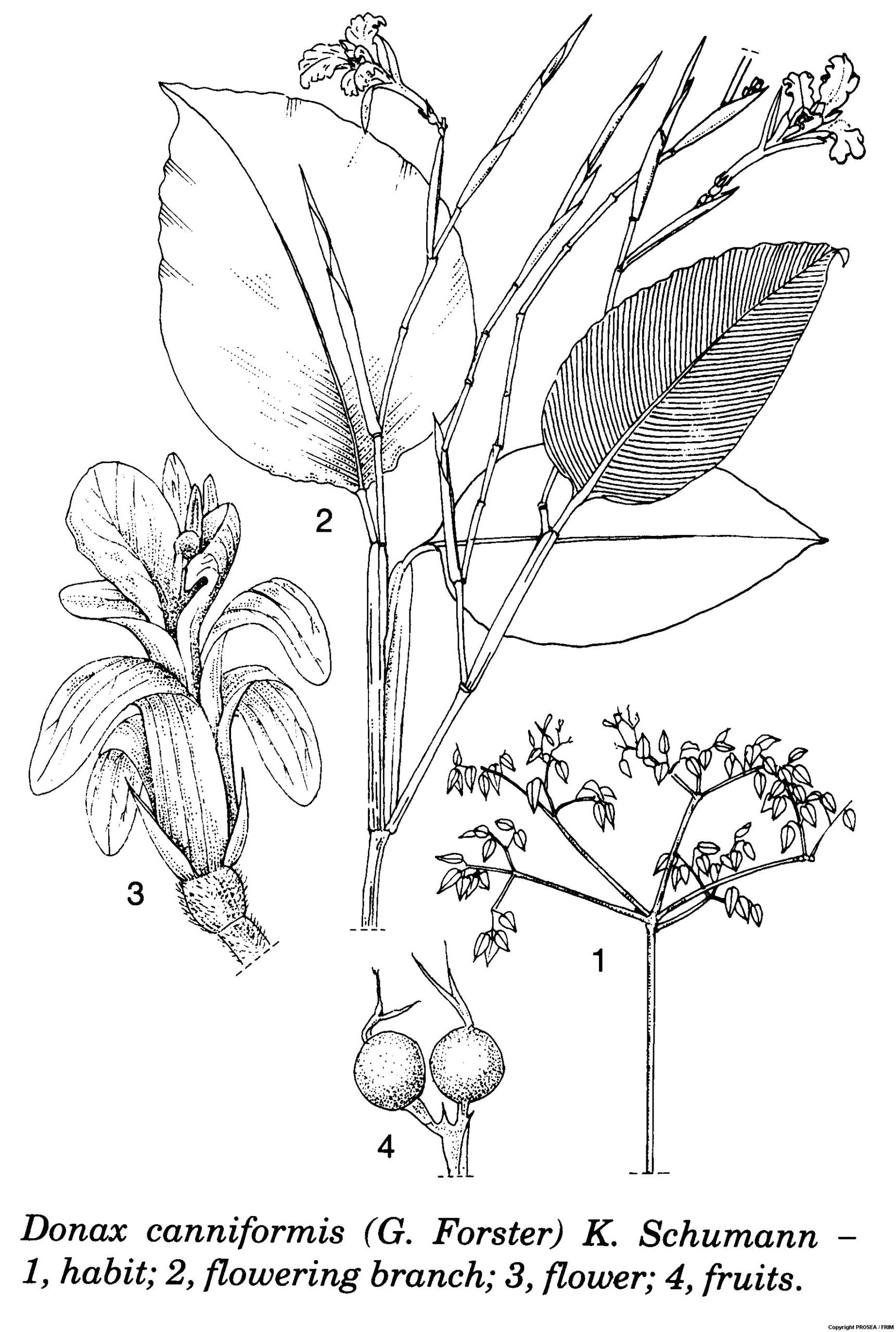
Donax canniformis is a perennial, stout, tufted rhizomatous, erect and shrub-like herb. It is 2-5 m tall, with true, slender and sympodially branching stems.
The leaves are all cauline, sheathed and thin-coriaceous. The sheath is up to 20 cm long. The ligule is very short. The petiole is 1-2.5 cm long, and thickened into a cylindrical and pulvinus pilose. The blade is broadly ovate to elliptical, measuring 10-45 cm x 4-25 cm, with rounded base, acuminate at apex and appressed-pilose along the midrib. The lateral veins are numerous and parallel.
The inflorescence is terminal on a leafy branch, slender paniculate, measures up to 20 cm long and branched at the base. Some partial inflorescences are condensed cymose (spike-like) in the axils of primary bracts. There are 9-11 bracts which are distichous, obovate to lance-shaped, measure 2.5-3.5 cm long and caducous. The pedicel is up to 5 mm long and thickened in fruit. Its flowers are in pairs. The bracteoles are two per flower pair and they are glandular. There are 3 free sepals, triangular-ovate, measure 3-5 mm long, white and hairless. The petal is tubular and 3-lobed, with tube 8-10 mm long, and linear lobes measuring 1-1.5 cm x 2-3 mm. The staminodes and stamen form a tube 3-4 mm long. There are 2 outer staminodes which are petaloid, subequal, obovate, measuring 12-14 mm x 5-6 mm and white, while the 2 inner staminodes are unequal and yellowish, where one is the fleshy (callose) staminode, petaloid and measures about 1.5 cm long. Inside at the base of the callose staminode is with a hairy thickened part and emarginated at apex. The other one is a hooded (cucullate) staminode. It is about 1 cm long, encloses the style and stigma in the hood and bears a broad lateral lobe. There is 1 fertile stamen which measures about 8 mm long with a narrow triangular appendage. The pistil is with a sericeous and 3-celled ovary. The style and stigma are held erect first by the hooded staminode and when released, the upper part springs downwards to form an inverted U while the stigma rests on the callus of the fleshy staminode.
The fruit is spherical to ellipsoid, measures 1-1.5 cm in diametre, dry, indehiscent, nearly smooth, whitish-cream and crowned by the withered flower. It is 1-2-seeded. The brown seed is spherical to ellipsoid, measures 7-8 mm in diametre, grooved and warty .
Ecology / Cultivation
In general, Donax canniformis grows in wet locations, such as swamps and periodically flooded areas. In Southeast Asia, it occurs up to about 1000 m altitude in secondary forests, teak forests and bamboo forests, but also in coconut plantations and near paddy fields.
Line Drawing / Photograph
References
- Plant Resources of South-East Asia No.17: Fibre plants.