

Lindernia crustacea (L.) F. Muell.
Family
Scrophulariaceae
Synonyms
Lindernia gracilis (Bonati) Bonati, Vandellia crustacea (L.) Benth.
Vernacular Names
| Malaysia | Akar kerak nasi, akar kelurut, rumput jari chechak |
| Brunei | Kerak nasi |
| Indonesia | Daun sirik betok (Jakarta), jukut mata keuyeup (Sundanese), brobos kebo (Javanese). |
| Cambodia | (Smau) chiëk to:k |
| Thailand | Yaa kaaphoi tua mia (Peninsular), to ti ke kang(Central) |
| Vietnam | M[aax]u th[ar]o, d[aa]y l[uw] [owr]i d[oof]ng |
Geographical Distributions
Throughout West Africa and Asia, including South-East Asia, Japan, northern Australia, Micronesia and Polynesia. It has recently been recorded from Texas (United States).
Description
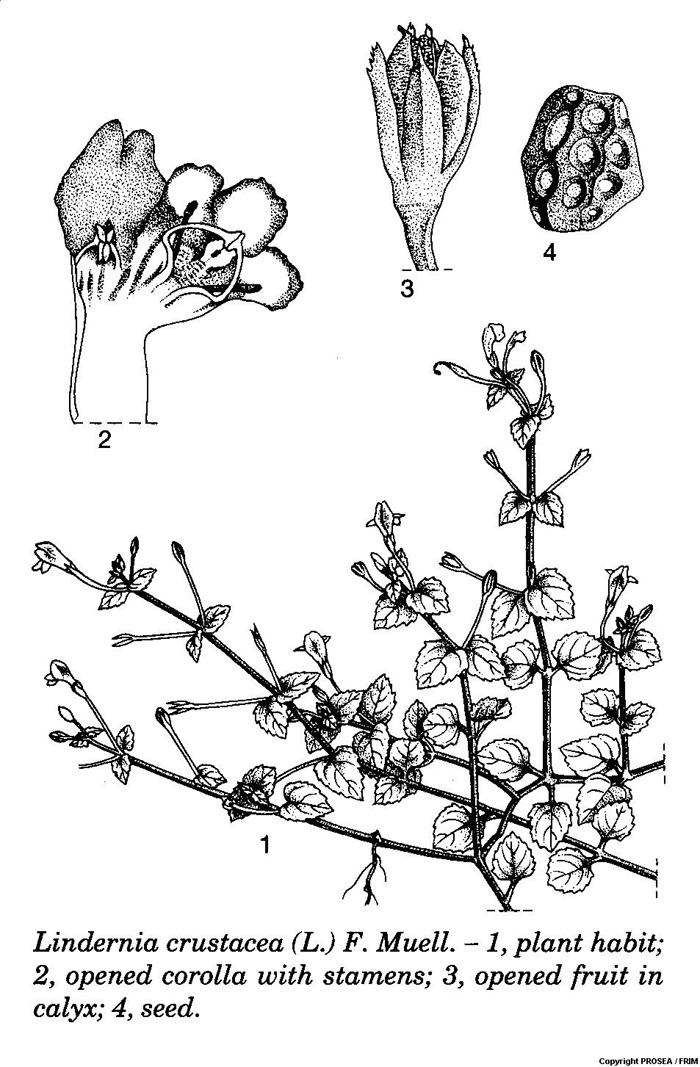
This species is a small, diffusely branched and annual to short-living perennial herb about 5-20 cm in height. The stems are sharply quadrangular to narrowly-winged, green to purple, hairy on angles and nodes.
The 8-20 mm long leaves are egg-shaped. Their bases are cordate while the margins are sub-entire to serrate and sparingly hairy.The petiole is 1-18 mm long while the flowers are axillary and solitary, unilateral or opposite. Its pedicel is 8-20 mm long. The petal is 9-12 mm long, tube sub-cylindrical, dark purple and base pale. The upper lip is erect, egg-shaped, purple; the apex is notched at the extremity and pale while the lower lip is broad, 3-lobed, white or pale purple and yellow spot at the base. It has four stamens and it spurs purple.
The capsule is oblong-ovoid to ellipsoid. Its size is 5-6 mm long, as long as the sepal. Its 0.4 mm long seed is ellipsoid with both ends blunt and covered with pale brown warty protuberances.
Ecology / Cultivation
L. crustacea occurs in moist, open grassy localities, rice fields, sugar-cane fields, riverbeds, ditches and disturbed soils, from sea-level up to 1500(-3000) m altitude.
Line Drawing / Photograph
References
-
Plant Resources of South-East Asia No 12(2). 1998, Unesco.