

Phaeanthus ebracteolatus (C. Presl) Merr.
Family
Annonaceae
Synonyms
Phaeanthus cumingii Miq., Phaeanthus macropodus (Miq.) Diels, Phaeanthus nigrescens Elmer.
Vernacular Names
|
Philippines |
Kalimatas (Tagalog), takulau (Iloko), lapnisan (Bisaya). |
|
Papua New Guinea |
Bien (Kebar). |
Geographical Distributions
Phaeanthus ebracteolatus is distributed in the Philippines, Brunei, Sabah, East Kalimantan, Sulawesi, the Lesser Sunda Islands, the Moluccas, Kai Islands, Aru Islands, Papua and Papua New Guinea.
Description
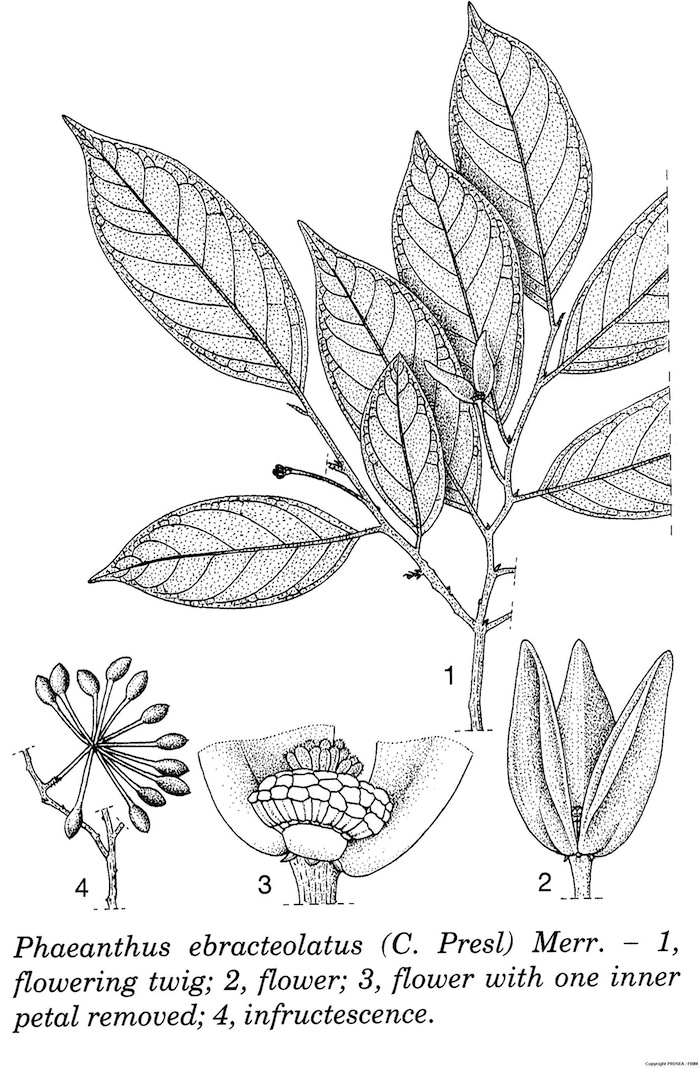
Phaeanthus ebracteolatus is a shrub or tree, up to 20 m tall and the trunk is up to 35 cm in diametre.
The leaves are obovate to elliptical, measure 7.4-25.3 cm x 2.6-10 cm, while the midrib is with 9-14 pairs of anastomosing veins. The cymes are sometimes reduced to one axis.
The flowers are solitary or 3(-4) together. The sepals and outer petals are 0.8-1.5 mm long while the inner petals are 1.2-2.9 cm long. There are 40-80 stamens, 30-50 carpels and with style absent.
There are 15-30 monocarps which measure 11-17 mm x 7-10 mm, smooth, with stalk 1.3-2.6 cm long, green to yellow to orange when immature before becoming dark red to purple when ripen.
Ecology / Cultivation
Phaeanthus ebracteolatus is common in primary and secondary lowland forests, on steep hills, especially ridges, on river banks and in open locations, on various soils up to 800 m altitude.
Line Drawing / Photograph
References
-
Plant Resources of South-East Asia No.12(2): Medicinal and poisonous plants 2.