

Sphaeranthus indicus L.
Family
Compositae
Synonyms
Sphaeranthus hirtus Willd., Sphaeranthus mollis Roxb. ex. DC.
Vernacular Names
|
English |
East Indian globe thistle. |
|
Indonesia |
Sembung, ki heuleut (Sundanese), brincil (Javanese). |
|
Laos |
Khi khoay (Louang-Prabang). |
|
Thailand |
Matom suea. |
|
Vietnam |
C[us]c ch[aa]n v[ij]t, c[or] tr[uws]ng v[ij]t. |
Geographical Distributions
Sphaeranthus indicus originates from India, and is now spreading throughout the Old World tropics, including China, Malaysia and Australia, as a weed. It is not recorded in Borneo, the Moluccas or Papua New Guinea.
Description
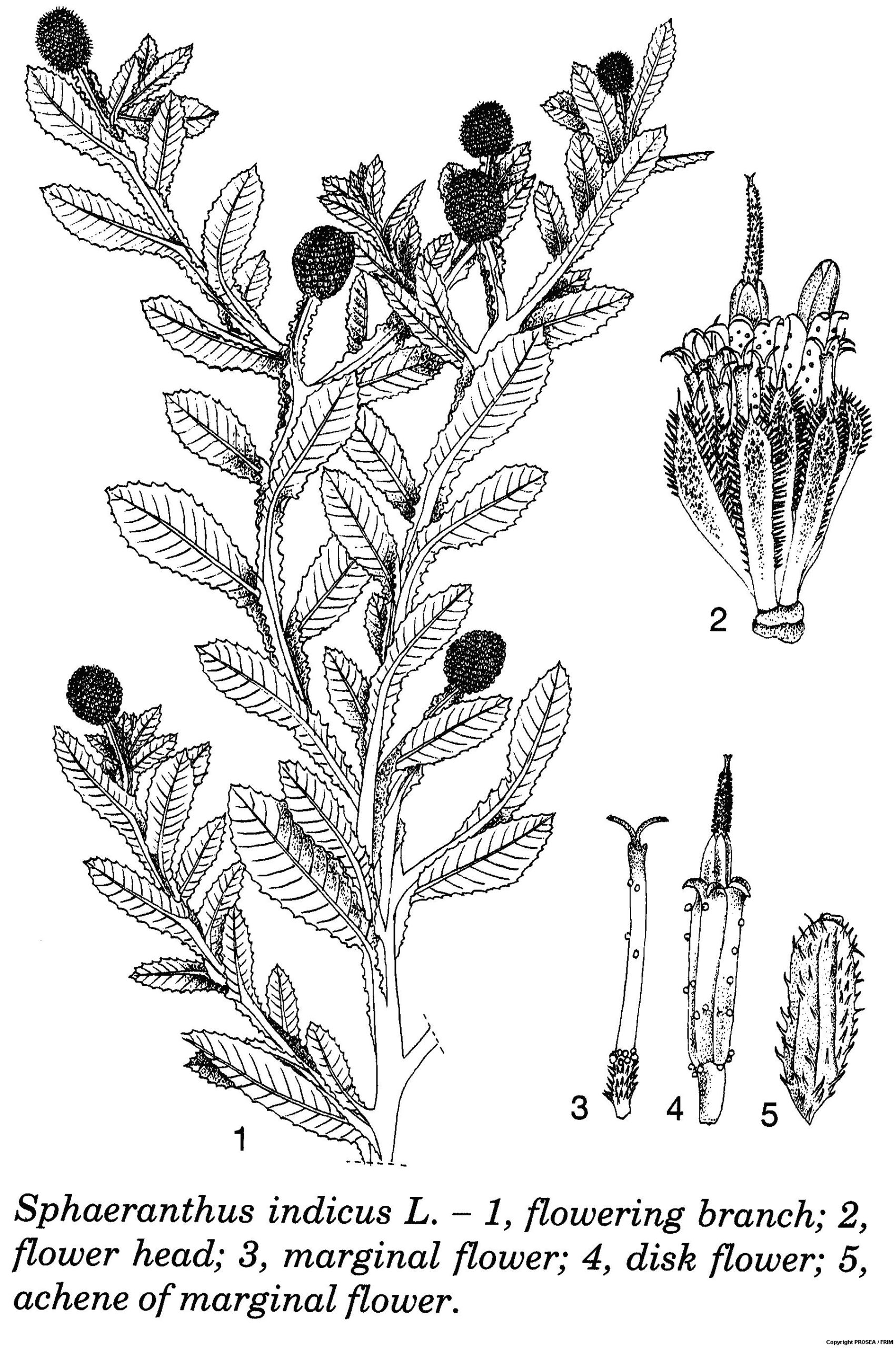
Sphaeranthus indicus is an annual, sticky-glandular, hairy herb that can grow up to 30-60 cm tall. The stem is divaricately branched especially in the top part.
The leaves are obovate-oblong, measure 1-8 cm x 0.5-2.5 cm, with serrate margins and irregularly serrate wings.
The glomerule is spherical-ellipsoid, 12-15 mm across and with ovate receptacle. There are about 20 involucral bracts, which are lance-shaped, whitish, and purple-tipped, while the upper half is densely hairy. The heads are small and numerous on very short secondary receptacles. There are 13-17 bracts, which are linear, 3 mm long, hairy and glandular.
There are 10-13 marginal flowers, with petal 2-3 mm long, 2-3-dentate, and with 3(-5) disk flowers, with flask-shaped petal, with the lower part becomes swollen, hardened and persistent at maturity, 1 mm across, narrowly cylindrical at the upper part, glandular, 3 mm long, 5-dentate, and with purple flowers. The achenes of the marginal flowers are ovoid-oblong, 4-5-angled, with hairy angles and brown, while achenes of the disk flowers are obconical, 4-5-angled, smooth or hairy.
Ecology / Cultivation
Sphaeranthus indicus is abundant in damp situations, ascending to an altitude of about 1500 m, especially as a weed in and along (fallowed) rice fields, along ditches, often in groups, especially on heavy soils. In Java, it flowers from May to February, while in India from September to March.
Line Drawing / Photograph
References
- Plant Resources of South-East Asia No.12(2): Medicinal and poisonous plants 2.