

Tylophora indica (Burm.f.) Merr.
Family
Asclepiadaceae
Synonyms
Tylophora asthmatica (L.f.) Wight & Arnott ex Wight.
Vernacular Names
|
Malaysia
|
Simbukan
|
|
English
|
Emetic swallow wort, Indian ipecacuanha (Indi
|
|
Thailand
|
Khun phuum (North-eastern), khanthulee, thaao phan raak (Peninsular)
|
|
Vietnam
|
Thu[oos]c hen, d[aaf]u d[afJi [aas]n d[ooj]
|
|
French
|
Ipéca sauvage
|
Geographical Distributions
From the Seychelles through India and Sri Lanka, to Southeast Asia including Malesia.
Description
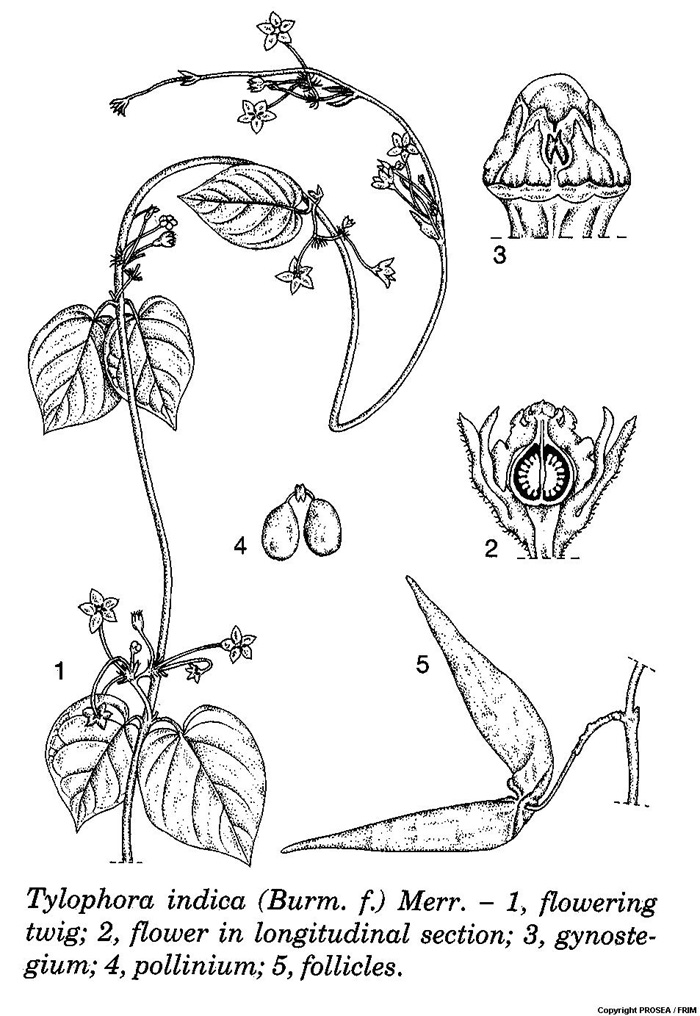
It’s a slender, hairy or smooth branching climber, up to 1.5 m tall. The rhizomes are short about 3-4 mm thick, knotty, with numerous fine roots .
The leaves are egg-shaped-oblong to orbicular measuring 3-10 cm x 1.5-7 cm. its base is heart-shaped or rounded while the apex is acute or obtuse. Its stalk is 0.5-2 cm long.
The flowers are few to many-flowered umbel-like cymes or sometimes 2 superposed umbellate cymes, shorter than or as long as the leaves. Sepal lobes are 1.5-2.5 mm long and lance-shaped. Petal is 1-1.5 cm in diametre, greenish-yellow out-side but purplish within. Follicles are spindle-shaped with size of 5-10 cm x 1 cm.
Ecology / Cultivation
T. indica is common along the coast on sandy soils, particularly on stabilized dunes and in sandy coconut plantations, up to 900 m altitude.
Line Drawing / Photograph
Read More
References
-
Plant Resources of South-East Asia No 12(2). 1998, Unesco.