

Scientific Name
Durio dulcis Becc.
Synonyms
Durio conicus Becc. [1]
Vernacular Name
| Malaysia | Lahong, layung, durian bala (Dayak); durian merah (Malay); durian isa (Iban); pesasang (Tidung) [3] |
Geographical Distributions
Durio dulcis is distributed throughout Borneo; occasionally also cultivated for the fruits. This plant occurs in lowland forest up to 800 m altitude. It is found scattered in mixed dipterocarp forest on sandy clay soils and friable clay loams. [2]
Botanical Description
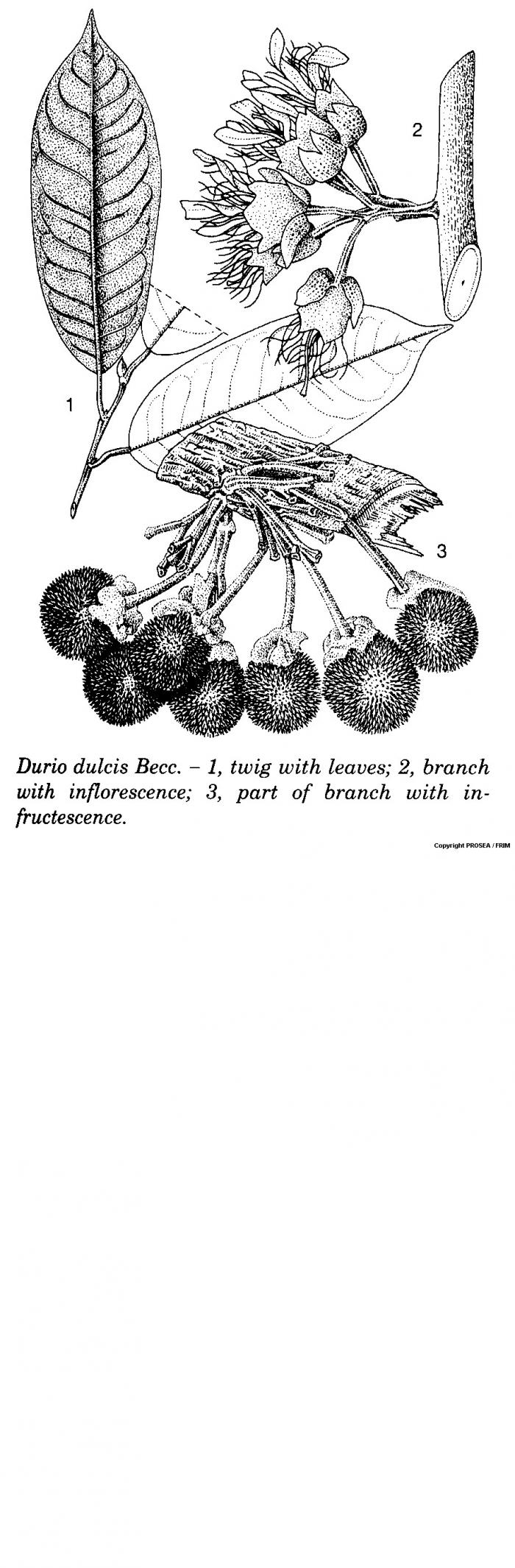
D. dulcis comes from the Bombacaceae family. It is a fair large tree that can reach up to measure 40 m tall. [2]
The bole is up to measure 80 cm in diametre and with large buttresses which are up to measure 4 m high. The bark surface is rough, superficially fissured or irregularly flaky and reddish-brown in colour. [2]
The leaves are elliptical or obovate-elliptical in shape, measuring about 7-14 cm x 3.5-6 cm and densely scaly below. [2]
The flowers are in short inflorescence clustered on the older branches. The petals are up to measure 45 mm long, pink in colour, stamens in bundles and opened by a slit. [2]
The fruit is spherical and up to measure 15 cm in diametre, while the outside is dark red to dark brown-red in colour with long slender spines and very strong smells. [2]
The seed is brown, each completely covered by a dark yellow aril. [3]
Cultivation
No documentation
Chemical Constituent
No documentation
Plant Part Used
No documentation
Traditional Use
No documentation
Preclinical Data
No documentation
Clinical Data
No documentation
Poisonous Management
No documentation
Line Drawing
References
- The Plant List. Ver1.1. Durio dulcis Becc.[homepage on the Internet]. c2013 [updated 2012 Mar 23; cited 2015 May 20]. Available from: http://www.theplantlist.org/tpl1.1/record/kew-2779439
- Lemmens RHMJ, Soerianegara I, Wong WC, editors. Plant Resources of South-East Asia No.5(2): Timber trees: Minor Commercial Timbers. Leiden, Netherlands: Backhuys Publishers; 1995.
- Jansen PCM, Jukema J, Oyen LPA, van Lingen TG. Durio dulcis Becc. In: Verheij EWM, Coronel RE, editors. Plant Resources of South-East Asia No. 2: Edible fruits and nuts. Wageningen, Netherlands: Pudoc Scientific Publisher, 1991; p. 330.