

Mahkota dewa fruit
Phaleria macrocarpa (Scheff.) Boerl.
Thymelaeaceae
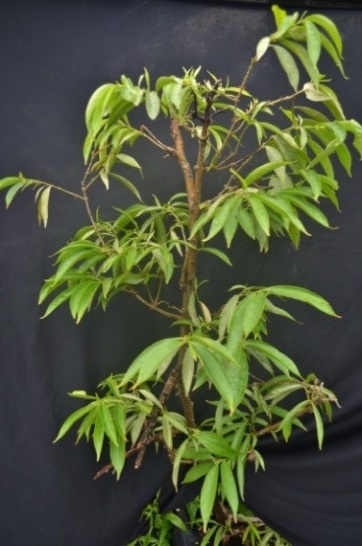
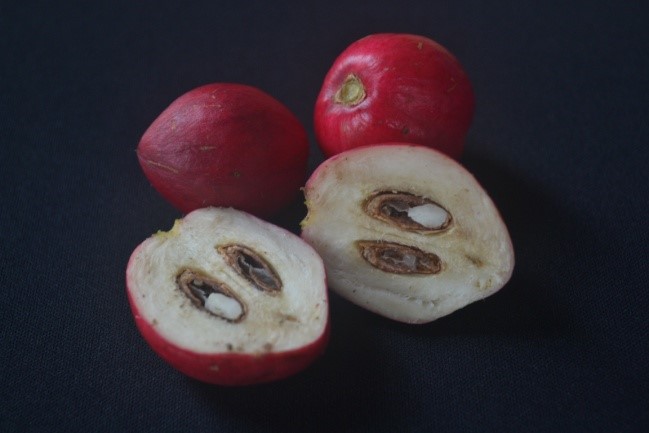
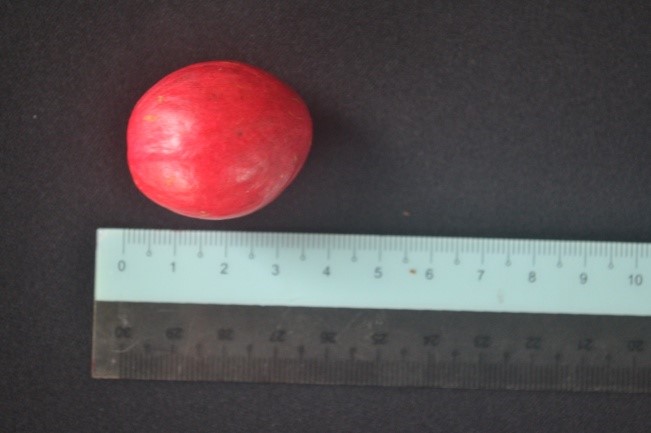
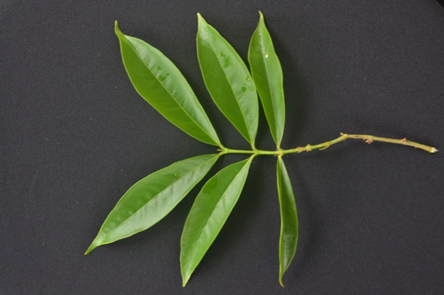
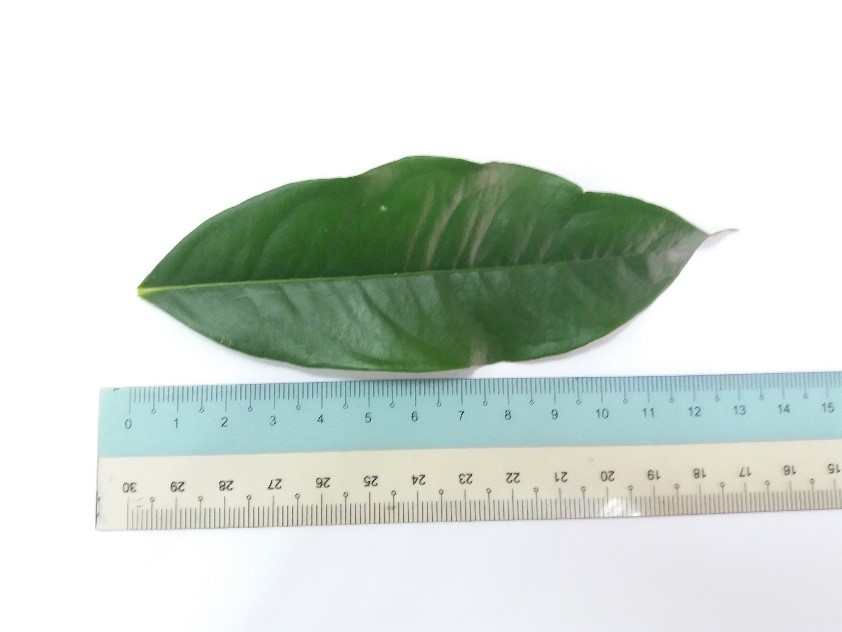
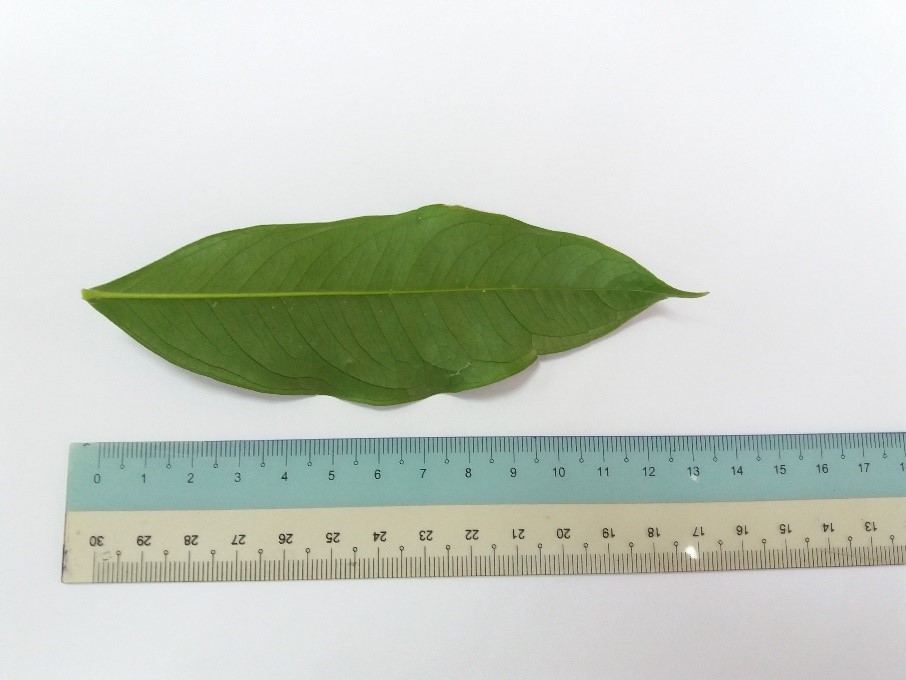
Figure 1 : Phaleria macrocarpa. (a) Plant habit; (b) cross section of fruits; (c) whole fruit; (d) opposite leaves arrangement; (e) adaxial leaf; (f) abaxial leaf. (Photo courtesy of Centre for Herbal Standardization, USM, 2016)
DEFINITION
Mahkota dewa fruit consists of the powder of dried deseeded fruits of Phaleria macrocarpa (Scheff.) Boerl.(Thymelaeaceae).
SYNONYM
Phaleria calantha Gilg, Phaleria papuana Warb. ex. K.Schum & Lauterb., Phaleria papuana var. wichmannii (Valeton)Backer, Phaleria wichmannii Valeton [ 1 ].
VERNACULAR NAMES
God’s crown (English); Mahkota dewa (Malay); Huang kuang (Chinese) [ 2 , 3 ].
CHARACTER
| Colour | Light brown |
| Odour | Unpleasant |
| Taste | Tasteless |
IDENTIFICATION
Plant Morphology
P. macrocarpa is a shrub or an evergreen tree, height ranges from 1–18 m, with 1 m long straight root exuding sap, erect trunk, cylindrical, up to about 15 cm of diameter, smooth or slightly wrinkled brownish bark and dense crown. Leaves simple, oppositely arrangement, elliptic to oblong lanceolate with pointed apex, 7–14 cm long and 3–5 cm broad, coriaceous, dark green in colour; petiole 0.5 cm long. Inflorescence umbel type, peduncle 0.3–2 cm long, borne in the axil of the leaves, carrying 2–5 white sessile flowers. Flowers tubular shaped, 1.5–3.5 cm long, whitish, fragrant, perfect flower with four sepals, four or five petals, 8 stamens and a carpel. Fruits simple, fleshy drupe with one or two seeds, round or elliptical in shape, matured fruit is 3–5 cm in diameter, colour of matured fruit is green and turns to brightly red or maroon when it ripens. Seeds dicotyledonous with exalbuminous seeds type, brown in colour, ovoid, anatropous and exist as 1-2 seeds per fruit [ 4 , 5 ].
Microscopy
Powdered material consists of basic tissues of parenchyma cells; fragment of a bundle of fibers; vessels are abundant, consisting of isolated spiral vessel or sometimes associated with pitted vessel, long or short fragments of annular vessels and scalariform thickenings.


Figure 2 : Microscopic characters of Phaleria macrocarpa dried fruit powder of 0.355 mm size. (a) endocarp of parenchyma cells (magnification 40x); (b) a bundle of fibres (magnification 10x); (c) spiral vessel (magnification 4x); (d) annular vessel (magnification 40x); (e) scalariform vessel (magnification 40x); (f) pitted vessel (arrow) (magnification 40x). [Scale bars: a= 20 µm; b= 50 µm; c= 100 µm; d= 10 µm; e= 10 µm; f= 10 µm]
Colour Tests
Observed colour of solution after treatment with various reagents:
| H2SO4 (conc.) | Brown |
| 5% (w/v) NaOH | Yellow |
Thin Layer Chromatography (TLC)

Figure 3 : TLC chromatogram of mangiferin (S), ethanol extract of Phaleria macrocarpa dried fruit powder (L) observed under (a) 366 nm before derivatization (b) 366 nm after derivatization.
| Test Solutions | Weigh about 1.0 g of P. macrocarpa dried fruit powder of 0.355 mm size in a 50 mL conical flask. Add 10 mL of ethanol and sonicate the mixture for 15 min at room temperature. Centrifuge the mixture for 5 min at 13,000 rpm and use the supernatant as test solution. |
| Standard solution | Dissolve mangiferin standard [CAS no.:4773-96-0] in ethanol to produce a standard concentration 1.0 mg/mL. |
| Stationary Phase | HPTLC Silica gel 60 F254 10×10 cm |
| Mobile phase |
Chloroform : acetone : formic acid : methanol; (35 : 40 : 8 : 15) (v/v/v/v) |
| Application |
|
| Development distance | 8 cm |
| Drying | Air drying |
| Detection |
|
High Performance Liquid Chromatography (HPLC)
| Test solution | Weigh about 1.0 g of P. macrocarpa dried fruit powder of 0.355 mm size in a 50 mL conical flask. Add 10 mL of ethanol and sonicate the mixture for 15 min at room temperature. Centrifuge the mixture for 5 min at 13,000 rpm and the supernatant is collected. An amount of 1 mL of supernatant is diluted with 3 mL of ethanol and used as test solution. | ||||||||||||||||||||||||
| Standard solution | Dissolve mangiferin standard [CAS no: 4773-96-0] in ethanol to produce a standard concentration 0.2 mg/mL. | ||||||||||||||||||||||||
| Chromatographic system |
Detector: 370 nm Column: Zorbax SB-C18 (150 X 4.6 mm, 3.5 µm) Column oven temperature: 25oC Flow rate: 1 mL/min Injection volume: 10 µL |
||||||||||||||||||||||||
| Mobile Phase (gradient mode) |
|
||||||||||||||||||||||||
| System suitability requirement |
Perform at least five replicate injections of the standard solution (0.2 mg/mL). The requirements of the system suitability parameters are as follow:
|
||||||||||||||||||||||||
| Acceptance criteria |
|

(a)

(b)
Figure 4 : Whole HPLC chromatogram of (a) mangiferin standard solution (0.2 mg/mL) at tr = 17.5 min and (b) ethanol extract of Phaleria macrocarpa dried fruit powder showing peak corresponding to mangiferin standard solution at tr = 17.5 min.

(a)

(b)
Figure 5 : HPLC chromatogram highlighting the elution region of mangiferin in (a) mangiferin standard solution (0.2 mg/mL) and (b) ethanol extract of Phaleria macrocarpa dried fruit powder showing peak corresponding to mangiferin standard solution at tr = 17.5 min.

Figure 6 : UV spectrum of mangiferin standard solution (0.2 mg/mL) and ethanol extract of Phaleria macrocarpa dried fruit powder.
PURITY TESTS
The purity tests are based on P. macrocarpa dried fruit powder of 0.355 mm particle size.
| Foreign Matter |
| Not more than 2% |
| Ash Contents | |
| Total ash | Not more than 10% |
| Acid-insoluble ash | Not more than 1% |
| Loss on Drying |
| Not more than 11% |
| Extractive Values | |
| Water-soluble extracts | |
| Hot method | Not less than 25% |
| Cold method | Not less than 17% |
| Ethanol-soluble extracts | |
| Hot method | Not less than 12% |
| Cold method | Not less than 6% |
SAFETY TESTS
The safety tests are based on P. macrocarpa dried fruit powder of 0.355 mm particle size
| Heavy Metals | |
| Arsenic | Not more than 5.0 mg/kg |
| Mercury | Not more than 0.5 mg/kg |
| Lead | Not more than 10.0 mg/kg |
| Cadmium | Not more than 0.3 mg/kg |
| Microbial Limits | |
| Total bacterial count | Not more than 105 cfu/g |
| Total yeast and mould count | Not more than 104 cfu/g |
| Bile-tolerant gram negative | Not more than 104 cfu/g |
| Specific Pathogens | |
| Salmonella spp. | Absent in 25 g |
| Escherichia coli | Absent in 1 g |
| Staphylococcus aureus | Absent in 1 g |
| Pseudomonas aeruginosa | Absent in 1 g |
CHEMICAL CONSTITUENTS
Aqueous extract of P. macrocarpa dried fruit was found to contain carbohydrate (glucose and sucrose) [ 6 ].
Methanol extract of pericarp and mesocarp of P. macrocarpa dried fruit was found to contain flavonoid compounds (kaempferol, myricetin, naringin, rutin and quercetin), glycosides (2,4’,6-trihydroxy-4-methoxybenzophenone-2- O-β-D-glycoside; phalerin and mangiferin) [ 7 , 8 ].
Ethanol extract (95%) of the pit of P. macrocarpa dried fruit was found to contain glycosides (4,4’-dihydroxy-2-methoxybenzo-phenone-6-O-β-D-glucopyranoside, mangiferin and kaempferol-3-O– β-D-glucoside), fatty acids (dodecanoic acid, palmitic acid and ethyl stearate) [ 9 ].
Ethyl acetate extract ofP. macrocarpa dried fruit was found to contain sterol (β-sitosterol and stigmasterol) and steroid (cycloargetanol), benzophenone derivatives (2,6,4’-trihydroxy-4-methoxybenzophenone and 6,4’-dihydroxy-4-methoxybenzophenone-2-O-β-D-glucopyranoside) [ 6 , 10 ].
Chloroform extract of P. macrocarpa driedfruit was found to contain triterpenoids (24-methylenecycloartan-3-one and 2,4-methyl-9,1,9-cyclolanost-25-en-3-ol), sesquiterpene glucoside (icariside C3 ) [ 8 , 11 ].
Hexane extract of P. macrocarpa dried fruit was found to contain fatty acids (palmitic acid, oleic acid, linoleic acid and linolenic acid) [ 6 ].
MEDICINAL USES
Uses described in folk medicine, not supported by experimental or clinical data
Traditionally used to alleviate flu and joint pain [ 12 ].
Biological and pharmacological activities supported by experimental data
Antibacterial activity
Methanol extract of P. macrocarpa dried fruit pericarp and mesocarp (300 µg/disc) inhibited the growth of Gram-positive bacteria Bacillus cereus, Bacillus subtilis, Micrococcus luteus and Staphylococcus aureus with zone of inhibition ranging from 1.47 – 2.33 cm compared to kanamycin (1 µg/disc) with inhibition zone ranging from 1.33 – 1.63 cm using disc diffusion method [ 7 ].
Methanol extract of P. macrocarpa dried fruit pericarp and mesocarp (300 µg/disc) inhibited the growth of Gram-negative bacteria Enterobacter aerogenes, Escherichia coli, Klebsiella pneumonia and Pseudomonas aeruginosa with zone of inhibition ranging from 1.10 – 2.17 cm compared to kanamycin (1 µg/disc) with inhibition zone ranging from 1.00 – 1.73 cm using disc diffusion method [ 7 ].
α-glucosidase inhibitory activity
Butanol fraction of methanol extract of P. macrocarpa dried young and ripe fruit pericarp (25 µg/mL) showed in vitro α-glucosidase inhibitory activity at 63.64% and 52.93% compared to quercetin (25 µg/mL) with inhibitory activity of 51.35% [ 13 ].
Cytotoxic activity
Methanol extract of P. macrocarpa dried fruit pericarp showed significant (p < 0.001) in vitro cytotoxic activity against human breast adenocarcinoma (MCF-7) (IC50 = 33.5 ± 1.74 μg/mL) and human cervical cancer cell line (HeLa) (IC50 = 40.8 ± 2.01 μg/mL) compared to positive control tamoxifen (MCF-7; IC50 = 24.2 ± 1.91 μg/mL and HeLa; IC50 = 28.8 ± 1.94 μg/mL) using MTT (3-(4,5-dimethylthiazol-2-yl)-2,5-diphenyltetrazolium bromide) assay [ 14 ].
Methanol extract of P. macrocarpa dried fruit mesocarp showed significant (p < 0.001) in vitro cytotoxic activity against human cervical cancer cell line (HeLa) (IC50 = 37.2±1.89 μg/mL) compared to positive control tamoxifen (IC50 = 28.8±1.94 μg/mL) using MTT assay [ 14 ].
Antihypercholesterolemic activity
Aqueous extract of P. macrocarpa dried flesh fruit pericarp (0, 20, 30 and 40 mg/mL) orally administered to male Sprague Dawley rats (350 g) for 84 days after the induction of hypercholesterolemia had significantly (p < 0.05) reduced total cholesterol (TC) (20 mg/kg; 36%, 30 mg/kg; 35%, 40 mg/kg; 22%), triglyceride (TG) (20 mg/kg; 66%, 30 mg/kg; 71%), high-density lipoprotein level (HDL) (20 mg/kg; 28%, 40 mg/kg; 22%) and low-density lipoprotein level (LDL) (20 mg/kg; 38%, 30 mg/kg; 34%, 40 mg/kg; 32%) compared reference drug simvastatin (40 mg/kg) reduced TC, TG and LDL level by 39%, 65% and 48%, respectively [ 15 ].
Anti-hyperglycemic activity
n-Butanol fraction of methanol extract of P. macrocarpa dried fruit pericarp (1 g/kg; w/w) was administered orally to fasting streptozotocin-induced male Sprague Dawley rats (200 – 250 g) for 12 days had significantly (p < 0.05) decreased the blood glucose level by 66.67% compared to metformin (250 mg/kg; 51.11%), glibenclamide (10 mg/kg; 66.67%) and insulin (5 units/kg; 71.43%) [ 16 ].
Improve sperm viability
Aqueous extract of P. macrocarpa dried fruit pericarp (240 mg/kg; w/w) administered orally to male Sprague Dawley rats (250 – 300g; 2 months old) for 6 weeks had showed significant (p < 0.05) increment of sperm viability (65.26 %) compared to control groups treated with distilled water (37.22%) and positive control, Andriol® Testocaps (4 mg/kg; 70.46%) [ 17 ].
Clinical studies
Information and data have not been established.
SAFETY INFORMATION
Preclinical studies (Toxicology studies)
Acute toxicity
Oral single dose acute toxicity study on Sprague Dawley rats (aged between 8 and 12 weeks old) using aqueous extract of P. macrocarpa fruits showed no toxic effect on the parameters observed, including behaviours, body weight, food and water intake. All rats were observed for 14 days prior to necropsy. No death was found throughout the study period. Necropsy revealed no significant abnormality. Half lethal dose (LD50) is 2,000 mg/kg body weight [ 18 ].
Others (Adverse reaction, contraindication, side effect, warning, precaution)
Information and data have not been established.
DOSAGE
Information and data have not been established.
STORAGE
Store below 30°C. Protect from light and moisture.
REFERENCES
- The Plant List [Internet]. Phaleria macrocarpa (Scheff.) Boerl, 2012 [cited on 7 April 2016]. Available from: http://www.theplantlist.org/tpl1.1/record/tro-50315226
- Anggraini T, Lewandowsky P. The exotic plants of Indonesia: Mahkota dewa (Phaleria macrocarpa), sikaduduak (Melastoma malabathricum Linn) and mengkudu (Morinda citrifolia) as potent antioxidant sources. International Journal on Advanced Science Engineering Information Technology. 2015; 5(2):115-118.
- Hai Kou Yi Yu Cao Mu Health Food Co. Ltd [Internet] Phaleria macrocarpa; 2015 [cited on 20 December 2016]. Available from: http://www.hkyycm.com/news2.aspx?cid=1&id=21
- Rabia A, Mohammad ZBA, Aidiahmad D, Amirin S, Muhammad IU. Phytochemistry and medicinal properties of Phaleria macrocarpa (Scheff.) Boerl. extracts. Pharmacognosy Review. 2013;7(13):73-80.
- Hasimah A, Nor Nafizah MN, Norhayati D, Hasnah I. The inflorescence and infructescence morphology of Phaleria macrocarpa (Boerl.) Scheff. Journal of Science and Mathematics. 2013;5:67-72.
- Simanjuntak P. Identifikasi senyawa kimia dalam buah Mahkota dewa (Phaleria macrocarpa), Thymelaceae. Jurnal Ilmu Kefarmasian Indonesia. 2008;6:23-28.
- Rudi H, Syahida A, Aspollah S, Yunus SM, Ehsan O. Flavonoid analyses and antimicrobial activity of various parts of Phaleria macrocarpa (Scheff.) Boerl fruit. International Journal of Molecular Sciences. 2011;12:3422-3431.
- Shiori O, Kazumasa Z, Yosuke M, Yusuke H, Toru I, Herra S, Gunawan I, Noor CZ, Hiroshi M. Studies on the constituents from the fruits of Phaleria macrocarpa. Journal of Natural Medicine. 2008; 62:207-210.
- Yan-Bang Z, Xiang-Jun X, Hong-Min L. Chemical constituents from Mahkota dewa. Journal of Asian Natural Product Research. 2006;8:119-123.
- Othman SNAM, Basar N, Siti PMB. Cytotoxic activity of major compounds from Phaleria macrocarpa (Scheff.) Boerl. fruits. Jurnal Teknologi. 2013; 64(2):53-56.
- Othman SNAM, Sarker SD, Talukdar AD, Ningthoujam SS, Khamis S, Basar N. Chemical constituents and antibacterial activity of Phaleria macrocarpa (Scheff.) Boerl. International Journal of Pharmaceutical Sciences and Research. 2014;5(8): 3157-3162.
- Harmanto N. Conquering disease in unison with Mahkota dewa. North Jakarta: Ir. Harmantop, 2003; p.14.
- Sri Sugiwati, Leonardus BS, Kardono, Maria Bintang. α-glucosidase inhibitory activity and hypoglycemic effect of Phaleria macrocarpa fruit pericarp extracts by oral administration to rats. Journal of Applied Sciences. 2006; 6(10):2312-2316.
- Rudi H,Syahida A,Ehsan O,Aspollah S, Yunus SM. Antioxidant, anti-inflammatory and cytotoxicity of Phaleria macrocarpa (Scheff.) Boerl fruit. BMC Complementary and Alternative Medicine. 2011;11:110-120.
- Soo CC, Mohamad AD, Pei PC, Abdullah M. Phaleria macrocarpa (Scheff.) Boerl fruit aqueous extract enhances LDL receptor and PCSK9 expression in vivo and in vitro Phaleria macrocarpa (Scheff.) Boerl fruit aqueous extract enhances LDL receptor and PCSK9 expression in vivo and in vitro. Journal of Ethnopharmacology. 2011;137(1): 817-827.
- Rabyah BA, Item JA, Navneet K, Omar SA, Mariam A, Roziahanim M, Mohd Zaini A. Bioassay-guided antidiabetic study of Phaleria macrocarpa fruit extract. Molecules. 2012;17:4986-5002.
- Parhizkar S, Yusoff MJ, Dollah MA. Effect of Phaleria macrocarpa on sperm characteristics in adult rats. Advanced Pharmaceutical Bulletin. 2013;3(2):345-352.
- Norzahirah A, Umi Rubiah SZ, Bazilah J, Nurul Syahira S, Dalnitha Lea N, Thavinraj R, Teh BP. Acute oral toxicity study of selected Malaysian medicinal herbs on Sprague Dawley rats. Institute for Medical Research, Ministry of Health; 2019. Report no.: NON-GLP/2019/06/01.